
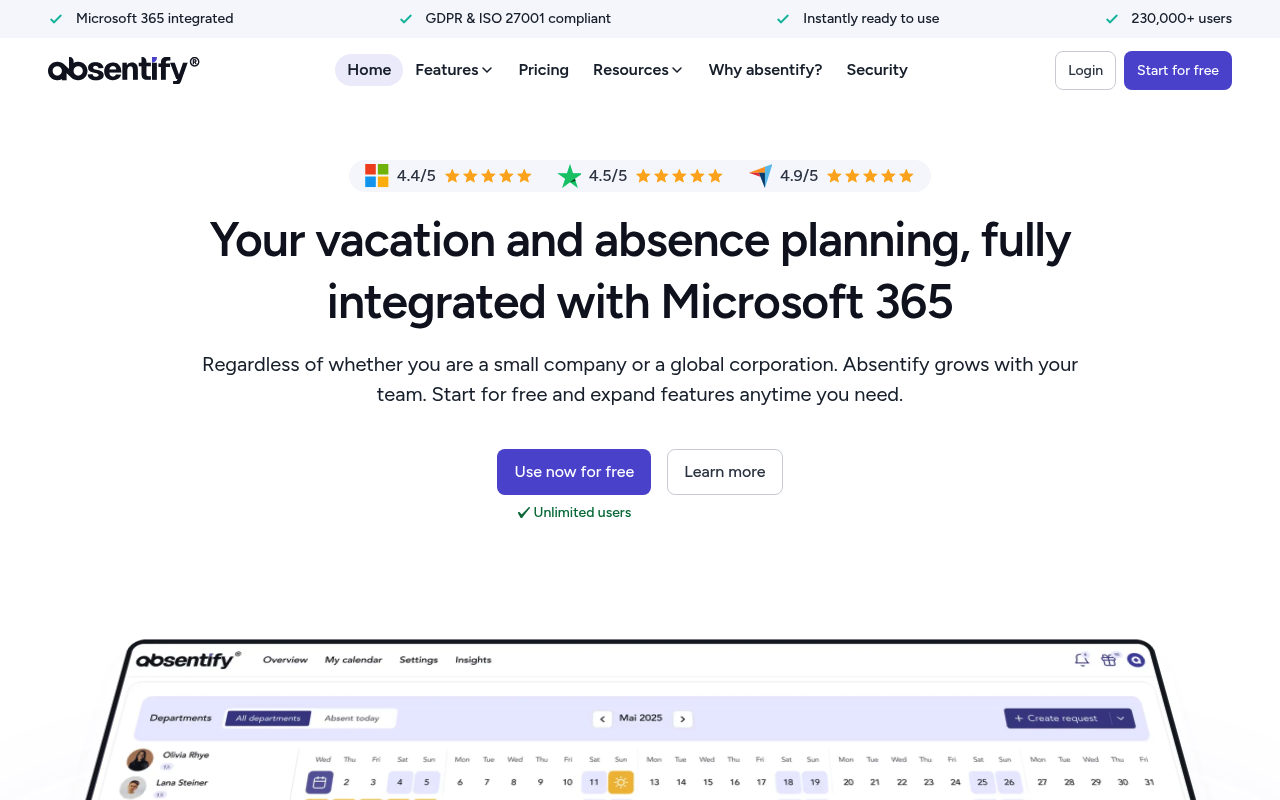
Absentify
Absentify is an absence management platform integrated with Microsoft 365 and Microsoft Teams that helps businesses track and manage employee absences, leave requests, approvals, and team schedules. Built by BrainCore Solutions GmbH, it provides a REST API for integrating absence management into custom workflows, HR systems, and business automation tools.
Real signal across most facets with visible, nameable gaps — the contract exists but is thin, or the portal is good while governance and commercial terms are absent.

API Evangelist profiles Absentify the way a machine reads it — 76 machine-readable artifacts across 1 API, pulled from the provider's own public surface and indexed so a developer, an analyst, or an AI agent can evaluate it against every other provider on the network.
Every provider in the network is reduced to the same set of machine-readable artifacts — OpenAPI contracts, event specifications, GraphQL schemas, runnable collections, pricing and rate-limit signals, security posture, OAuth scopes, and the agent surfaces (MCP servers and skills) that let software drive the API on its own. We profile them because the interface is the part of a company you can actually inspect: it is a truer signal of what a provider does than any marketing page. From those artifacts we compute the Kin Score — Absentify scores 49.0/100 (developing), with a separate agent-readiness read of 27/100 (agent aware). The full breakdown is below, followed by every artifact we hold — each card links through to its machine-readable definition on apis.io.
Kin Score
This is the API Evangelist rating — a single, repeatable read computed from the artifacts on this page. Green fill is points earned; the red track is points possible, so every bar shows earned-versus-possible at a glance. Every facet and dimension name is a link: it opens that measurement's page on APIs.io, where the rating runs across the whole catalog — the exact checks that feed it, how every profiled provider distributes on it, and who is at the top of it.
Kin Score
How this is scored →scored 2026-10-17 · rubric v0.24.0

Put this on your own site. The badge is drawn live from Absentify's current Kin Score — paste it once and it updates itself every time the score is recomputed. It follows your visitor's light or dark setting, and it links back here so anyone who sees it can read the full breakdown.
<!-- Kin Score · API Evangelist -->
<a href="https://providers.apievangelist.com/providers/absentify/"
   title="Absentify on API Evangelist — API profile and Kin Score">
  <img src="https://apis.io/badge/absentify.svg"
       alt="Absentify Kin Score — API readiness rating by API Evangelist" width="150" height="150" loading="lazy">
</a>[](https://providers.apievangelist.com/providers/absentify/)<!-- Kin Score · API Evangelist -->
<a href="https://providers.apievangelist.com/providers/absentify/"
title="Absentify on API Evangelist — API profile and Kin Score">
<img src="https://apis.io/badge/absentify/card.svg"
alt="Absentify Kin Score — API readiness rating by API Evangelist" width="340" height="120" loading="lazy">
</a>More shapes, themes and sizes → · Score as JSON · How badges work
How we profile Absentify
Each block below is one kind of artifact we hold for Absentify. For each we say what it is and why it earns a place in the profile, then list every one we've indexed — capped at two rows, scroll within the panel for the rest.
APIs 7
Each API is captured as its own OpenAPI definition — every operation, parameter, and response. This is the single most useful machine-readable description of what an API does, and it's what lets us score, lint, mock, and generate against it without asking the provider for anything.
Individual APIs this provider publishes, each with its own machine-readable definition.
Absentify Absences API
The Absences API from Absentify — 1 operation(s) for absences.
Absentify Departments API
The Departments API from Absentify — 2 operation(s) for departments.
Absentify Leave types API
The Leave types API from Absentify — 3 operation(s) for leave types.
Absentify Members API
The Members API from Absentify — 10 operation(s) for members.
Absentify Public holidays API
The Public holidays API from Absentify — 2 operation(s) for public holidays.
Absentify Requests API
The Requests API from Absentify — 9 operation(s) for requests.
Absentify Workspace API
The Workspace API from Absentify — 1 operation(s) for workspace.
Scroll within the panel for all 7 ·
Postman Collections 7
A runnable collection turns the contract into something a developer can execute in seconds. We profile them because the fastest way to trust an API is to make a real call against it.
Ready-to-run Postman collections for exercising this provider's APIs.
Absentify Absences API
POSTMANScroll within the panel for all 7 ·
Open Collections 9
Open, tool-agnostic collections carry the same runnable value as Postman without locking you to one client — the portable, forkable form of the same exercise.
Open, tool-agnostic API collections (OpenAPI-derived and Bruno).
API Collection
OPEN COLLECTIONAbsentify Absences API
OPEN COLLECTIONAbsentify Absences Departments API
OPEN COLLECTIONAbsentify Absences Leave types API
OPEN COLLECTIONAbsentify Absences Members API
OPEN COLLECTIONAbsentify Absences Public holidays API
OPEN COLLECTIONAbsentify Absences Requests API
OPEN COLLECTIONAbsentify Absences Workspace API
OPEN COLLECTIONAbsentify API
OPEN COLLECTIONScroll within the panel for all 9 ·
Pricing Plans 1
Pricing is part of the interface. Machine-readable plans tell you what a tier costs and includes before you commit — one of the things the Kin Score reads for access clarity — renamed from commercial clarity in rubric 0.12, because a free statutory interface has access terms and no commercial ones.
Published pricing tiers and plan structures.
Rate Limits 1
Rate limits are the difference between a demo that works and a production integration that doesn't fall over. Publishing them is an operational-transparency signal — and a hard requirement for any agent that plans its own throughput.
Documented rate limits and quota policies.
Absentify Rate Limits
RATE LIMITSFinOps 1
Cost, billing, and metering signals let a buyer model the financial operations of an API before it's live. We profile them for the same reason we profile pricing: the money is part of the contract.
Cost, billing, and metering signals for API financial operations.
Absentify Finops
FINOPSFeatures 9
The notable capabilities this provider advertises, captured as structured features so they can be searched and compared instead of read one landing page at a time.
Notable capabilities this provider offers.
Absence Tracking
Track and manage employee absences, time off, and leave requests across the organization.
Leave Request Management
Submit, approve, decline, and cancel leave requests with multi-level approval workflows.
Microsoft 365 Integration
Native integration with Microsoft 365 and Microsoft Teams for seamless absence management in existing workflows.
Department Management
Organize employees into departments with custom leave type entitlements and approval chains.
Leave Type Configuration
Define custom leave types with color coding, limits, approval requirements, and accrual policies.
Public Holiday Calendars
Manage public holiday calendars per region and apply them to members and departments.
Webhook Support
Receive real-time webhook notifications for request creation and status changes.
Workspace Management
Configure workspace-wide settings, fiscal year, and default approval workflows.
Absence Per Day Reporting
Query absences broken down by individual day for reporting and payroll integration.
Scroll within the panel for all 9 ·
Semantic Vocabularies 1
JSON-LD contexts give the data shared meaning across APIs. We profile them because semantics are what let a machine reconcile 'customer' here with 'customer' somewhere else.
JSON-LD contexts and semantic vocabularies used across these APIs.
Absentify Context
JSON-LDSpectral Rules 2
Governance rulesets we run against this provider's specs — the automated checks behind parts of the score. Profiling them makes the quality bar explicit and re-runnable, not a matter of opinion.
Absentify — jsonschema rules
SPECTRALAbsentify API Rules
SPECTRALJSON Schema 7
Standalone JSON Schema definitions describe the data models behind the API. We profile them so the shapes are validatable on their own — useful long after a single request is forgotten.
Standalone JSON Schema definitions for this provider's data models.
Absence
JSON SCHEMADepartment
JSON SCHEMALeaveType
JSON SCHEMAMember
JSON SCHEMAPublicHolidayCalendar
JSON SCHEMARequest
JSON SCHEMAWorkspace
JSON SCHEMAScroll within the panel for all 7 ·
JSON Structure 7
JSON Structure captures the data shapes in a form built for tooling — a complement to JSON Schema that keeps the model machine-legible.
JSON Structure definitions describing this provider's data shapes.
Absentify Absence Structure
JSON STRUCTUREAbsentify Department Structure
JSON STRUCTUREAbsentify Leave Type Structure
JSON STRUCTUREAbsentify Member Structure
JSON STRUCTUREAbsentify Public Holiday Calendar Structure
JSON STRUCTUREAbsentify Request Structure
JSON STRUCTUREAbsentify Workspace Structure
JSON STRUCTUREScroll within the panel for all 7 ·
Examples 7
Real request and response payloads are what turn a spec from abstract into obvious — and they're one of the twelve things an agent needs to call an API correctly on the first try.
Example request and response payloads for these APIs.
Absentify Absence Example
EXAMPLEAbsentify Department Example
EXAMPLEAbsentify Leave Type Example
EXAMPLEAbsentify Member Example
EXAMPLEAbsentify Request Example
EXAMPLEAbsentify Workspace Example
EXAMPLEScroll within the panel for all 7 ·
Security Posture 4
Authentication, domain security, vulnerability disclosure, and trust-center signals — the evidence that a provider takes security seriously enough to document it. We profile it because you can't govern what you can't see.
Authentication, domain security, vulnerability disclosure, and trust-center signals.
Agentic Access 1
An x-agentic-access contract marks which operations are safe for an agent to run on its own and which need a human in the loop. It is the difference between an API an agent can use and one it can use safely.
Recommended x-agentic-access execution contracts for AI agents.
Use Cases 7
What developers actually build with this provider — captured so the catalogue answers 'what is this for', not just 'what does this expose'.
What developers build with this provider.
HR System Integration
Integrate absence data into HRIS platforms like SAP, Workday, or BambooHR for unified people management.
Payroll Processing
Export absence data to payroll systems to automatically calculate pay adjustments for time off.
Team Scheduling
Sync absence data into scheduling tools to prevent understaffing and manage coverage.
Compliance Reporting
Generate absence reports for regulatory compliance, labor law adherence, and audit purposes.
Custom Approval Workflows
Build custom absence request approval workflows integrated with business process automation tools.
Absence Analytics
Analyze absence trends, patterns, and costs to improve workforce planning and reduce absenteeism.
Microsoft Teams Automation
Automate absence-related notifications and approvals directly within Microsoft Teams channels.
Scroll within the panel for all 7 ·
Integrations 5
Pre-built integrations with other platforms tell you where this provider already fits in a stack.
Pre-built integrations with other platforms and tools.
Microsoft Teams
Native Microsoft Teams app for submitting and approving absence requests without leaving Teams.
Microsoft 365
Deep integration with Microsoft 365 calendar, Active Directory, and identity management.
Zapier
Connect absentify to thousands of apps via Zapier automation workflows.
Make (Integromat)
Automate absence management workflows using Make's visual automation platform.
Custom Webhooks
Send real-time absence event notifications to any system via configurable webhooks.
Resources
Every other property we hold for Absentify — documentation, portals, status pages, policies, and corporate surface — grouped by the job it does, following the integrator's arc from getting started to running in production.
Get Started 1
Portal, sign-up, and the first successful call
Documentation 1
Reference material describing how the API behaves
Agent Surfaces 1
MCP servers, agent skills, and machine-readable catalogs
Design & Contract 2
Pagination, idempotency, versioning, errors, and events
Build 2
SDKs, sample code, and the tooling you integrate with
Access & Security 5
Authentication, authorization, and security posture
Operate 2
Status, limits, changes, and where to get help
Commercial 5
Pricing, plans, and the legal terms of use
Company 3
The organization behind the API
Other 1
Properties that don't map to a standard resource type
← All providers · Data indexed from github.com/api-evangelist/absentify · machine-readable index on apis.io
This is an independent, third-party profile of Absentify, published by API Evangelist. We do not operate, host, resell, or support these APIs, and we are not affiliated with or endorsed by the company unless stated above. Everything here is built from publicly available information — the company's own site, developer portal, documentation, public repositories, and the specifications it publishes for public use. Nothing is obtained by breaching a system, defeating an access control, or using credentials.
The Kin Score and Agent Readiness rating are independently calculated assessments of a company's public API artifacts, scored against a published rubric. They are not certifications, endorsements, security assessments, or audits.
Corrections, re-scores, and removal are free — no partnership or purchase required, and you do not need to justify the request. A removed company is recorded as unrated, never scored zero for having asked. Acknowledgement within one business day; removal within two.
info@apievangelist.com
·
Read the full data-sourcing policy →
On a security or compliance team? Put security in the subject line and
you will get a person, not a form — we will tell you exactly which public URLs this profile was built from.