
Applitools
Applitools is a Visual AI testing platform for end-to-end functional, visual, and API testing. The product line covers Eyes (Visual AI inside existing test frameworks), Autonomous (no-code AI-powered E2E platform), Execution Cloud (self-healing cloud test runner), and Ultrafast Grid (cross-browser/device visual rendering). Applitools exposes a REST server API at eyesapi.applitools.com and ships SDKs for Selenium, Cypress, Playwright, WebdriverIO, Puppeteer, Appium, Espresso, XCUI, Robot Framework, and more across JavaScript, TypeScript, Java, Python, C#, and Ruby.
Limited machine-readable signal and partial portal coverage — documentation a human can read, but little a machine or agent can consume without scraping.

API Evangelist profiles Applitools the way a machine reads it — 48 machine-readable artifacts across 1 API, pulled from the provider's own public surface and indexed so a developer, an analyst, or an AI agent can evaluate it against every other provider on the network.
Every provider in the network is reduced to the same set of machine-readable artifacts — OpenAPI contracts, event specifications, GraphQL schemas, runnable collections, pricing and rate-limit signals, security posture, OAuth scopes, and the agent surfaces (MCP servers and skills) that let software drive the API on its own. We profile them because the interface is the part of a company you can actually inspect: it is a truer signal of what a provider does than any marketing page. From those artifacts we compute the Kin Score — Applitools scores 30.6/100 (thin), with a separate agent-readiness read of 20/100 (agent aware). The full breakdown is below, followed by every artifact we hold — each card links through to its machine-readable definition on apis.io.
Kin Score
This is the API Evangelist rating — a single, repeatable read computed from the artifacts on this page. Green fill is points earned; the red track is points possible, so every bar shows earned-versus-possible at a glance. Every facet and dimension name is a link: it opens that measurement's page on APIs.io, where the rating runs across the whole catalog — the exact checks that feed it, how every profiled provider distributes on it, and who is at the top of it.
Kin Score
How this is scored →scored 2026-11-06 · rubric v0.27.0
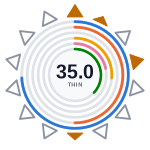
Put this on your own site. The badge is drawn live from Applitools's current Kin Score — paste it once and it updates itself every time the score is recomputed. It follows your visitor's light or dark setting, and it links back here so anyone who sees it can read the full breakdown.
<!-- Kin Score · API Evangelist -->
<a href="https://providers.apievangelist.com/providers/applitools/"
   title="Applitools on API Evangelist — API profile and Kin Score">
  <img src="https://apis.io/badge/applitools.svg"
       alt="Applitools Kin Score — API readiness rating by API Evangelist" width="150" height="150" loading="lazy">
</a>[](https://providers.apievangelist.com/providers/applitools/)<!-- Kin Score · API Evangelist -->
<a href="https://providers.apievangelist.com/providers/applitools/"
title="Applitools on API Evangelist — API profile and Kin Score">
<img src="https://apis.io/badge/applitools/card.svg"
alt="Applitools Kin Score — API readiness rating by API Evangelist" width="340" height="120" loading="lazy">
</a>More shapes, themes and sizes → · Score as JSON · How badges work
How we profile Applitools
Each block below is one kind of artifact we hold for Applitools. For each we say what it is and why it earns a place in the profile, then list every one we've indexed — capped at two rows, scroll within the panel for the rest.
APIs 36
Each API is captured as its own OpenAPI definition — every operation, parameter, and response. This is the single most useful machine-readable description of what an API does, and it's what lets us score, lint, mock, and generate against it without asking the provider for anything.
Individual APIs this provider publishes, each with its own machine-readable definition.
Applitools Eyes Server REST API
REST API for the Applitools Eyes cloud server. Endpoint groups include Batch Management (results, statistics, properties, deletion), Discussions (list and manage comments), and ...
Applitools Eyes SDKs
Visual testing SDKs that integrate with existing test frameworks (Selenium, Cypress, Playwright, WebdriverIO, Puppeteer, Appium, Espresso, XCUI, Robot Framework, Images) across ...
Applitools Autonomous
AI-powered no-code platform for end-to-end functional, visual, and API testing. Handles test authoring, result analysis, and provides REST API access for programmatic integratio...
Applitools Execution Cloud
Cloud test execution infrastructure with self-healing capabilities - tests remain functional even when UI elements change. Drop-in remote WebDriver replacement for Selenium, Pla...
Applitools Ultrafast Grid
Cross-browser and device visual rendering grid. Renders DOM snapshots captured by Eyes SDKs across many browser/viewport combinations in parallel and applies Visual AI comparison.
Applitools Accessibility Reports API
The AccessibilityReports API from Applitools — 4 operation(s) for accessibilityreports.
Applitools Activities API
The Activities API from Applitools — 3 operation(s) for activities.
Applitools Admin API
The Admin API from Applitools — 53 operation(s) for admin.
Applitools App API
The App API from Applitools — 42 operation(s) for app.
Applitools Auth API
The Auth API from Applitools — 13 operation(s) for auth.
Applitools Auth Public API
The AuthPublicApi API from Applitools — 1 operation(s) for authpublicapi.
Applitools Autonomous API
The Autonomous API from Applitools — 1 operation(s) for autonomous.
Applitools Baselines API
The Baselines API from Applitools — 32 operation(s) for baselines.
Applitools Batches Public API
The BatchesPublicApi API from Applitools — 7 operation(s) for batchespublicapi.
Applitools Beta API
The Beta API from Applitools — 1 operation(s) for beta.
Applitools Debug API
The Debug API from Applitools — 3 operation(s) for debug.
Applitools Discuss API
The Discuss API from Applitools — 6 operation(s) for discuss.
Applitools Discuss Public API
The DiscussPublicApi API from Applitools — 1 operation(s) for discusspublicapi.
Applitools Execution Reports API
The ExecutionReports API from Applitools — 1 operation(s) for executionreports.
Applitools Externals API
The Externals API from Applitools — 92 operation(s) for externals.
Applitools Files API
The Files API from Applitools — 5 operation(s) for files.
Applitools Health API
The Health API from Applitools — 1 operation(s) for health.
Applitools Images API
The Images API from Applitools — 21 operation(s) for images.
Applitools Indexed Sessions API
The IndexedSessions API from Applitools — 18 operation(s) for indexedsessions.
Applitools Insights API
The Insights API from Applitools — 6 operation(s) for insights.
Applitools Locators API
The Locators API from Applitools — 6 operation(s) for locators.
Applitools Messages API
The Messages API from Applitools — 2 operation(s) for messages.
Applitools Metrics API
The Metrics API from Applitools — 2 operation(s) for metrics.
Applitools Product Usage API
The ProductUsage API from Applitools — 5 operation(s) for productusage.
Applitools Scm Integrations API
The ScmIntegrations API from Applitools — 1 operation(s) for scmintegrations.
Applitools Sessions API
The Sessions API from Applitools — 77 operation(s) for sessions.
Applitools Summaries API
The Summaries API from Applitools — 1 operation(s) for summaries.
Applitools Tasks API
The Tasks API from Applitools — 2 operation(s) for tasks.
Applitools Tasks V2 API
The TasksV2 API from Applitools — 1 operation(s) for tasksv2.
Applitools Tiny Link API
The TinyLink API from Applitools — 1 operation(s) for tinylink.
Applitools Tutorial API
The Tutorial API from Applitools — 2 operation(s) for tutorial.
Scroll within the panel for all 36 ·
Open Collections 4
Open, tool-agnostic collections carry the same runnable value as Postman without locking you to one client — the portable, forkable form of the same exercise.
Open, tool-agnostic API collections (OpenAPI-derived and Bruno).
Applitools Eyes Server REST Batches API
OPEN COLLECTIONApplitools Eyes Server REST Batches Discussions API
OPEN COLLECTIONApplitools Eyes Server REST Batches SCM API
OPEN COLLECTIONApplitools Eyes Server REST API
OPEN COLLECTIONPricing Plans 1
Pricing is part of the interface. Machine-readable plans tell you what a tier costs and includes before you commit — one of the things the Kin Score reads for access clarity — renamed from commercial clarity in rubric 0.12, because a free statutory interface has access terms and no commercial ones.
Published pricing tiers and plan structures.
Rate Limits 1
Rate limits are the difference between a demo that works and a production integration that doesn't fall over. Publishing them is an operational-transparency signal — and a hard requirement for any agent that plans its own throughput.
Documented rate limits and quota policies.
Applitools Rate Limits
RATE LIMITSFinOps 1
Cost, billing, and metering signals let a buyer model the financial operations of an API before it's live. We profile them for the same reason we profile pricing: the money is part of the contract.
Cost, billing, and metering signals for API financial operations.
Applitools Finops
FINOPSSpectral Rules 1
Governance rulesets we run against this provider's specs — the automated checks behind parts of the score. Profiling them makes the quality bar explicit and re-runnable, not a matter of opinion.
Applitools API Rules
SPECTRALSecurity Posture 3
Authentication, domain security, vulnerability disclosure, and trust-center signals — the evidence that a provider takes security seriously enough to document it. We profile it because you can't govern what you can't see.
Authentication, domain security, vulnerability disclosure, and trust-center signals.
Agentic Access 1
An x-agentic-access contract marks which operations are safe for an agent to run on its own and which need a human in the loop. It is the difference between an API an agent can use and one it can use safely.
Recommended x-agentic-access execution contracts for AI agents.
Resources
Every other property we hold for Applitools — documentation, portals, status pages, policies, and corporate surface — grouped by the job it does, following the integrator's arc from getting started to running in production.
Documentation 1
Reference material describing how the API behaves
Agent Surfaces 1
MCP servers, agent skills, and machine-readable catalogs
Build 1
SDKs, sample code, and the tooling you integrate with
Access & Security 3
Authentication, authorization, and security posture
Operate 1
Status, limits, changes, and where to get help
Commercial 2
Pricing, plans, and the legal terms of use
Company 3
The organization behind the API
Other 1
Properties that don't map to a standard resource type
← All providers · Data indexed from github.com/api-evangelist/applitools · machine-readable index on apis.io
This is an independent, third-party profile of Applitools, published by API Evangelist. We do not operate, host, resell, or support these APIs, and we are not affiliated with or endorsed by the company unless stated above. Everything here is built from publicly available information — the company's own site, developer portal, documentation, public repositories, and the specifications it publishes for public use. Nothing is obtained by breaching a system, defeating an access control, or using credentials.
The Kin Score and Agent Readiness rating are independently calculated assessments of a company's public API artifacts, scored against a published rubric. They are not certifications, endorsements, security assessments, or audits.
Corrections, re-scores, and removal are free — no partnership or purchase required, and you do not need to justify the request. A removed company is recorded as unrated, never scored zero for having asked. Acknowledgement within one business day; removal within two.
info@apievangelist.com
·
Read the full data-sourcing policy →
On a security or compliance team? Put security in the subject line and
you will get a person, not a form — we will tell you exactly which public URLs this profile was built from.