
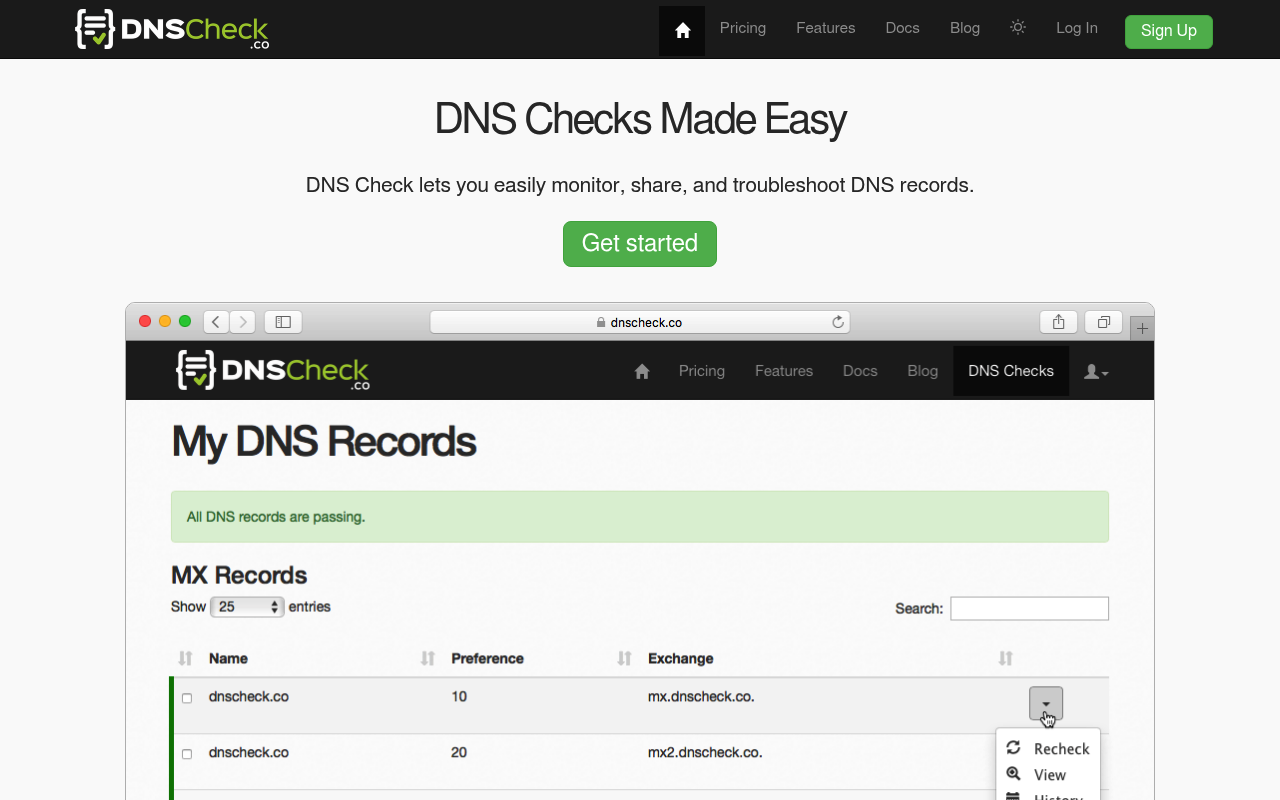
DNS Check
DNS Check is a domain DNS monitoring service that lets teams monitor, share, and troubleshoot DNS records across multiple record types (A, AAAA, CNAME, MX, NS, PTR, SOA, SPF, SRV, TXT). The platform detects unresponsive name servers, incorrect IP addresses, missing or duplicated records, SPF record problems, and out-of-sync name servers, with notifications when records change or fail. The DNS Check REST API provides programmatic access to DNS record and DNS record group monitoring using a 32-character API key passed as a query parameter.
Limited machine-readable signal and partial portal coverage — documentation a human can read, but little a machine or agent can consume without scraping.

API Evangelist profiles DNS Check the way a machine reads it — 8 machine-readable artifacts across 1 API, pulled from the provider's own public surface and indexed so a developer, an analyst, or an AI agent can evaluate it against every other provider on the network.
Every provider in the network is reduced to the same set of machine-readable artifacts — OpenAPI contracts, event specifications, GraphQL schemas, runnable collections, pricing and rate-limit signals, security posture, OAuth scopes, and the agent surfaces (MCP servers and skills) that let software drive the API on its own. We profile them because the interface is the part of a company you can actually inspect: it is a truer signal of what a provider does than any marketing page. From those artifacts we compute the Kin Score — DNS Check scores 28.2/100 (thin), with a separate agent-readiness read of 20/100 (agent aware). The full breakdown is below, followed by every artifact we hold — each card links through to its machine-readable definition on apis.io.
Kin Score
This is the API Evangelist rating — a single, repeatable read computed from the artifacts on this page. Green fill is points earned; the red track is points possible, so every bar shows earned-versus-possible at a glance. Every facet and dimension name is a link: it opens that measurement's page on APIs.io, where the rating runs across the whole catalog — the exact checks that feed it, how every profiled provider distributes on it, and who is at the top of it.
Kin Score
How this is scored →scored 2026-10-17 · rubric v0.24.0

Put this on your own site. The badge is drawn live from DNS Check's current Kin Score — paste it once and it updates itself every time the score is recomputed. It follows your visitor's light or dark setting, and it links back here so anyone who sees it can read the full breakdown.
<!-- Kin Score · API Evangelist -->
<a href="https://providers.apievangelist.com/providers/dns-check/"
   title="DNS Check on API Evangelist — API profile and Kin Score">
  <img src="https://apis.io/badge/dns-check.svg"
       alt="DNS Check Kin Score — API readiness rating by API Evangelist" width="150" height="150" loading="lazy">
</a>[](https://providers.apievangelist.com/providers/dns-check/)<!-- Kin Score · API Evangelist -->
<a href="https://providers.apievangelist.com/providers/dns-check/"
title="DNS Check on API Evangelist — API profile and Kin Score">
<img src="https://apis.io/badge/dns-check/card.svg"
alt="DNS Check Kin Score — API readiness rating by API Evangelist" width="340" height="120" loading="lazy">
</a>More shapes, themes and sizes → · Score as JSON · How badges work
How we profile DNS Check
Each block below is one kind of artifact we hold for DNS Check. For each we say what it is and why it earns a place in the profile, then list every one we've indexed — capped at two rows, scroll within the panel for the rest.
APIs 2
Each API is captured as its own OpenAPI definition — every operation, parameter, and response. This is the single most useful machine-readable description of what an API does, and it's what lets us score, lint, mock, and generate against it without asking the provider for anything.
Individual APIs this provider publishes, each with its own machine-readable definition.
DNS Check REST API
RESTful JSON API for managing DNS record monitors and DNS record group monitors at DNSCheck.co. All requests use GET and authenticate via a 32-character API key passed as the ap...
DNS Check DNS Record Monitoring API
The DNS Record Monitoring API from DNS Check — 1 operation(s) for dns record monitoring.
Open Collections 3
Open, tool-agnostic collections carry the same runnable value as Postman without locking you to one client — the portable, forkable form of the same exercise.
Open, tool-agnostic API collections (OpenAPI-derived and Bruno).
API Collection
OPEN COLLECTIONDNS Check DNS Record Monitoring API
OPEN COLLECTIONDNS Check API
OPEN COLLECTIONSecurity Posture 2
Authentication, domain security, vulnerability disclosure, and trust-center signals — the evidence that a provider takes security seriously enough to document it. We profile it because you can't govern what you can't see.
Authentication, domain security, vulnerability disclosure, and trust-center signals.
Agentic Access 1
An x-agentic-access contract marks which operations are safe for an agent to run on its own and which need a human in the loop. It is the difference between an API an agent can use and one it can use safely.
Recommended x-agentic-access execution contracts for AI agents.
Resources
Every other property we hold for DNS Check — documentation, portals, status pages, policies, and corporate surface — grouped by the job it does, following the integrator's arc from getting started to running in production.
Get Started 1
Portal, sign-up, and the first successful call
Documentation 2
Reference material describing how the API behaves
Agent Surfaces 1
MCP servers, agent skills, and machine-readable catalogs
Access & Security 2
Authentication, authorization, and security posture
Commercial 1
Pricing, plans, and the legal terms of use
Company 4
The organization behind the API
Other 1
Properties that don't map to a standard resource type
← All providers · Data indexed from github.com/api-evangelist/dns-check · machine-readable index on apis.io
This is an independent, third-party profile of DNS Check, published by API Evangelist. We do not operate, host, resell, or support these APIs, and we are not affiliated with or endorsed by the company unless stated above. Everything here is built from publicly available information — the company's own site, developer portal, documentation, public repositories, and the specifications it publishes for public use. Nothing is obtained by breaching a system, defeating an access control, or using credentials.
The Kin Score and Agent Readiness rating are independently calculated assessments of a company's public API artifacts, scored against a published rubric. They are not certifications, endorsements, security assessments, or audits.
Corrections, re-scores, and removal are free — no partnership or purchase required, and you do not need to justify the request. A removed company is recorded as unrated, never scored zero for having asked. Acknowledgement within one business day; removal within two.
info@apievangelist.com
·
Read the full data-sourcing policy →
On a security or compliance team? Put security in the subject line and
you will get a person, not a form — we will tell you exactly which public URLs this profile was built from.