
FastMCP
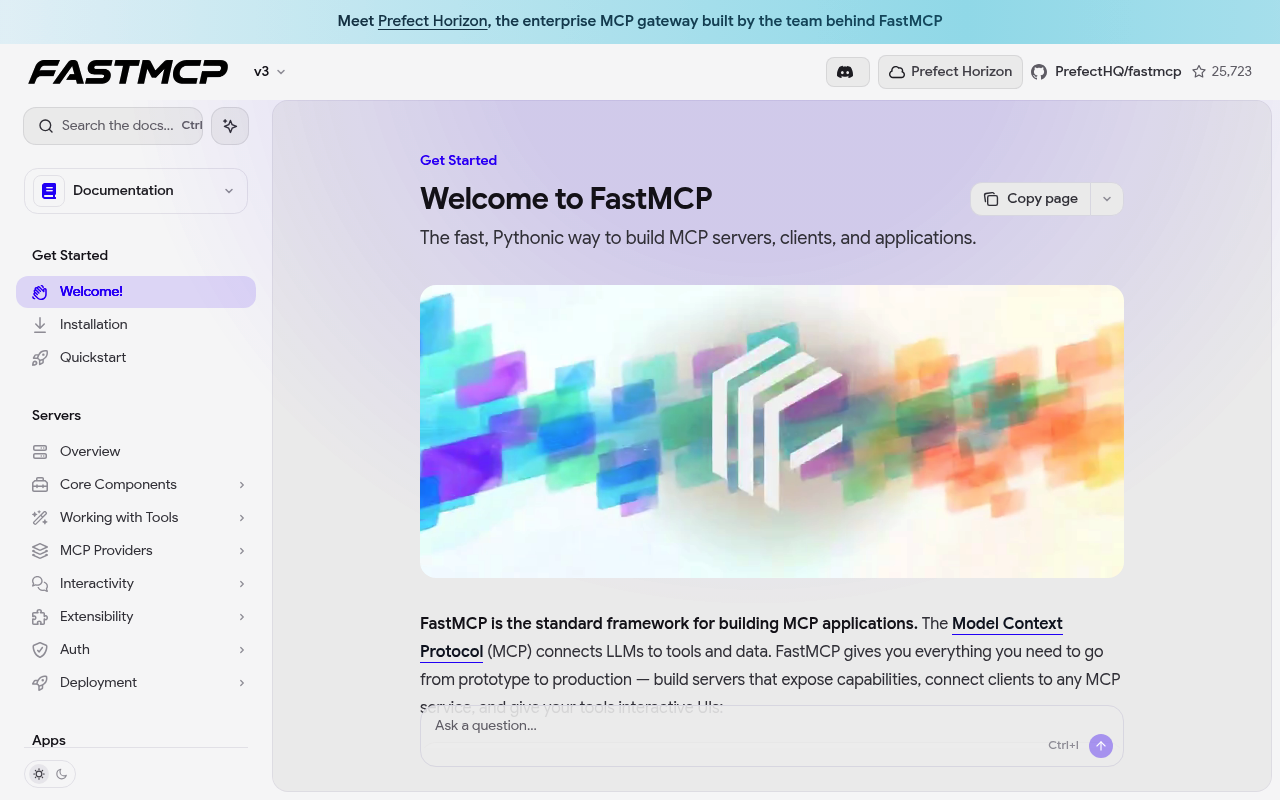
FastMCP is the fast, Pythonic framework for building Model Context Protocol (MCP) servers, clients, and apps. Originally created by Jeremiah Lowin and maintained by PrefectHQ, FastMCP 1.0 was adopted into the official Anthropic MCP Python SDK in 2024, and the standalone FastMCP project (now at v3) remains the most widely used way to ship MCP servers in Python — the project reports powering roughly 70% of MCP servers across all languages. FastMCP turns ordinary Python functions into MCP tools, resources, prompts, and apps via decorators, auto-generates JSON Schemas from type hints, handles transport negotiation (stdio, Streamable HTTP, SSE), and ships first-class OAuth/OIDC authentication, server composition and proxying, OpenAPI/FastAPI import, a CLI for running and installing servers into Claude Desktop / Claude Code / Cursor / ChatGPT / Gemini CLI / Goose, middleware, lifespan management, elicitation, sampling, progress reporting, OpenTelemetry, and a client library and apps runtime for building interactive UIs rendered inside MCP host conversations.
More than an index entry, but the surface is still mostly links rather than artifacts — the cohort most likely to move a full band from modest, well-targeted work.

API Evangelist profiles FastMCP the way a machine reads it — 46 machine-readable artifacts across 6 APIs, pulled from the provider's own public surface and indexed so a developer, an analyst, or an AI agent can evaluate it against every other provider on the network.
Every provider in the network is reduced to the same set of machine-readable artifacts — OpenAPI contracts, event specifications, GraphQL schemas, runnable collections, pricing and rate-limit signals, security posture, OAuth scopes, and the agent surfaces (MCP servers and skills) that let software drive the API on its own. We profile them because the interface is the part of a company you can actually inspect: it is a truer signal of what a provider does than any marketing page. From those artifacts we compute the Kin Score — FastMCP scores 18.2/100 (emerging), with a separate agent-readiness read of 6/100 (agent aware). The full breakdown is below, followed by every artifact we hold — each card links through to its machine-readable definition on apis.io.
Kin Score
This is the API Evangelist rating — a single, repeatable read computed from the artifacts on this page. Green fill is points earned; the red track is points possible, so every bar shows earned-versus-possible at a glance. Every facet and dimension name is a link: it opens that measurement's page on APIs.io, where the rating runs across the whole catalog — the exact checks that feed it, how every profiled provider distributes on it, and who is at the top of it.
Kin Score
How this is scored →scored 2026-10-17 · rubric v0.24.0

Put this on your own site. The badge is drawn live from FastMCP's current Kin Score — paste it once and it updates itself every time the score is recomputed. It follows your visitor's light or dark setting, and it links back here so anyone who sees it can read the full breakdown.
<!-- Kin Score · API Evangelist -->
<a href="https://providers.apievangelist.com/providers/fastmcp/"
   title="FastMCP on API Evangelist — API profile and Kin Score">
  <img src="https://apis.io/badge/fastmcp.svg"
       alt="FastMCP Kin Score — API readiness rating by API Evangelist" width="150" height="150" loading="lazy">
</a>[](https://providers.apievangelist.com/providers/fastmcp/)<!-- Kin Score · API Evangelist -->
<a href="https://providers.apievangelist.com/providers/fastmcp/"
title="FastMCP on API Evangelist — API profile and Kin Score">
<img src="https://apis.io/badge/fastmcp/card.svg"
alt="FastMCP Kin Score — API readiness rating by API Evangelist" width="340" height="120" loading="lazy">
</a>More shapes, themes and sizes → · Score as JSON · How badges work
How we profile FastMCP
Each block below is one kind of artifact we hold for FastMCP. For each we say what it is and why it earns a place in the profile, then list every one we've indexed — capped at two rows, scroll within the panel for the rest.
APIs 6
Each API is captured as its own OpenAPI definition — every operation, parameter, and response. This is the single most useful machine-readable description of what an API does, and it's what lets us score, lint, mock, and generate against it without asking the provider for anything.
Individual APIs this provider publishes, each with its own machine-readable definition.
FastMCP Server
The FastMCP Server is the Python entry point for exposing tools, resources, prompts, and apps to any Model Context Protocol client. Developers instantiate a `FastMCP` server obj...
FastMCP Client
The FastMCP Client is a Python client library for talking to any MCP server — local or remote — with full protocol coverage. It supports calling tools, reading resources, gettin...
FastMCP Apps
FastMCP Apps is the framework's runtime for building interactive applications rendered directly inside MCP host conversations. Apps expose UI surfaces — approval flows, choice p...
FastMCP Authentication
FastMCP ships a complete authentication and authorization layer for MCP servers. Servers can verify tokens, terminate OAuth flows directly, or proxy to an external OAuth or OIDC...
FastMCP OpenAPI and FastAPI Integration
FastMCP can generate an MCP server directly from an existing OpenAPI 3.x description or a FastAPI application, turning every HTTP operation into an MCP tool with auto-generated ...
FastMCP CLI
The FastMCP CLI is a developer command-line tool for running, inspecting, installing, and debugging MCP servers built with FastMCP. It can launch servers under any transport, in...
MCP Servers 1
Model Context Protocol servers expose these APIs directly to AI agents. We profile them because agent-native access is the fastest-growing way this provider's capabilities actually get used.
Model Context Protocol servers that expose these APIs to AI agents.
Features 16
The notable capabilities this provider advertises, captured as structured features so they can be searched and compared instead of read one landing page at a time.
Notable capabilities this provider offers.
Decorator-based tools, resources, and prompts
Turn Python functions into MCP tools, resources, and prompts with @mcp.tool / @mcp.resource / @mcp.prompt; schemas are auto-generated from type hints.
FastMCP Server, Client, and Apps
Three composable surfaces — Server (expose), Client (consume), Apps (interactive UI) — sharing a single runtime, transport, and auth stack.
Transport negotiation
Built-in support for stdio, Streamable HTTP, and SSE transports with zero boilerplate.
First-class authentication
Token verification, OAuth Proxy, OIDC Proxy, remote OAuth, full OAuth server, multi-auth sources, and 15+ provider integrations (Auth0, Cognito, Azure/Entra, GitHub, Google, Dis...
Authorization providers
Permit.io and Eunomia integrations for policy-driven authorization.
OpenAPI and FastAPI import
Generate an MCP server directly from an OpenAPI spec or FastAPI app so existing REST APIs become agent-callable in one step.
Server composition and proxying
Mount servers under namespaces, proxy to other MCP servers (including local, filesystem, and skills providers), and transform tools/prompts/resources between surfaces.
Middleware and dependency injection
Wrap requests with middleware and inject runtime dependencies into tool handlers.
Lifespan, context, logging, progress, elicitation
Full MCP protocol coverage including lifespan management, request context, structured logging, progress reporting, and user elicitation.
LLM sampling and background tasks
Client APIs for LLM sampling against the host model and for spawning background tasks.
OpenTelemetry instrumentation
Built-in OpenTelemetry tracing for servers.
Tool transforms
Tool Transformation, Tool Search, Prompts-as-Tools, Resources-as-Tools, Namespace, Component Visibility, and Code Mode transforms.
Pagination, versioning, storage backends, icons
Production-grade primitives for paginated responses, server versioning, pluggable storage backends, and component icons.
CLI for running and installing servers
Run, inspect, install, and generate FastMCP servers and clients; one-line install into Claude Desktop, Claude Code, Cursor, ChatGPT, and Gemini CLI.
Apps runtime
Approval, Choice, Form Input, and File Upload providers plus prefab, generative, and low-level HTML apps rendered inside MCP host conversations.
Anthropic-adopted lineage
FastMCP 1.0 was incorporated into the official Anthropic MCP Python SDK; the standalone FastMCP project (now v3) continues as the leading Python framework, reportedly powering ~...
Scroll within the panel for all 16 ·
Security Posture 1
Authentication, domain security, vulnerability disclosure, and trust-center signals — the evidence that a provider takes security seriously enough to document it. We profile it because you can't govern what you can't see.
Authentication, domain security, vulnerability disclosure, and trust-center signals.
Use Cases 7
What developers actually build with this provider — captured so the catalogue answers 'what is this for', not just 'what does this expose'.
What developers build with this provider.
Wrap an existing REST API as an MCP server
Point FastMCP at an OpenAPI spec or FastAPI app to expose every operation as an MCP tool without rewriting handlers.
Build agent-callable internal tools
Expose internal utilities (databases, search, ticketing, CI/CD, infra) to Claude, ChatGPT, Cursor, or any MCP host as governed tools.
Ship interactive MCP apps
Use FastMCP Apps to render approval prompts, choice pickers, forms, and file uploads inside agent conversations.
Proxy and compose third-party MCP servers
Aggregate multiple MCP servers behind a single namespaced surface with the proxy and namespace transforms.
Add OAuth/OIDC to an MCP deployment
Drop in one of 15+ identity providers to authenticate real users into an MCP server without writing OAuth plumbing.
Production deployment of MCP servers
Deploy MCP servers over HTTP with structured config, sandboxed agents, OpenTelemetry, and optional Prefect Horizon for managed runtime.
Local agent tooling
Install FastMCP servers into Claude Desktop, Claude Code, Cursor, ChatGPT, or Gemini CLI via the FastMCP CLI for stdio-based local agent workflows.
Scroll within the panel for all 7 ·
Integrations 15
Pre-built integrations with other platforms tell you where this provider already fits in a stack.
Pre-built integrations with other platforms and tools.
Anthropic API
First-party integration with the Anthropic Messages API; FastMCP 1.0 was adopted into the official Anthropic MCP Python SDK.
Model Context Protocol
Reference implementation of the Anthropic-stewarded Model Context Protocol specification.
OpenAI API
Connect FastMCP servers to OpenAI models and the OpenAI API.
Google Gemini
Integration with Google Gemini SDK and Gemini CLI.
Pydantic AI
Drop FastMCP servers into Pydantic AI agents.
Claude Desktop
One-line install for FastMCP servers into Claude Desktop.
Claude Code
Install FastMCP servers into Claude Code as MCP tools.
Cursor
Install FastMCP servers into the Cursor editor.
ChatGPT
Install FastMCP servers into ChatGPT.
Goose
Integration with Block's Goose agent runtime.
OpenAPI
Import any OpenAPI 3.x spec and serve it as an MCP server.
FastAPI
Wrap a FastAPI app as an MCP server with one line.
Auth0, AWS Cognito, Azure/Entra ID, GitHub, Google, Discord, Keycloak, OCI IAM, Supabase, WorkOS, AuthKit, Descope, PropelAuth, Scalekit
First-class OAuth provider integrations for authenticating MCP servers.
Permit.io and Eunomia
Policy-driven authorization integrations.
Prefect Horizon
Managed deployment platform for MCP servers from the FastMCP maintainers at PrefectHQ.
Scroll within the panel for all 15 ·
Resources
Every other property we hold for FastMCP — documentation, portals, status pages, policies, and corporate surface — grouped by the job it does, following the integrator's arc from getting started to running in production.
Get Started 3
Portal, sign-up, and the first successful call
Documentation 12
Reference material describing how the API behaves
Scroll within the panel for all 12 ·
Build 4
SDKs, sample code, and the tooling you integrate with
Access & Security 2
Authentication, authorization, and security posture
Operate 6
Status, limits, changes, and where to get help
Commercial 1
Pricing, plans, and the legal terms of use
Company 2
The organization behind the API
Other 2
Properties that don't map to a standard resource type
← All providers · Data indexed from github.com/api-evangelist/fastmcp · machine-readable index on apis.io
This is an independent, third-party profile of FastMCP, published by API Evangelist. We do not operate, host, resell, or support these APIs, and we are not affiliated with or endorsed by the company unless stated above. Everything here is built from publicly available information — the company's own site, developer portal, documentation, public repositories, and the specifications it publishes for public use. Nothing is obtained by breaching a system, defeating an access control, or using credentials.
The Kin Score and Agent Readiness rating are independently calculated assessments of a company's public API artifacts, scored against a published rubric. They are not certifications, endorsements, security assessments, or audits.
Corrections, re-scores, and removal are free — no partnership or purchase required, and you do not need to justify the request. A removed company is recorded as unrated, never scored zero for having asked. Acknowledgement within one business day; removal within two.
info@apievangelist.com
·
Read the full data-sourcing policy →
On a security or compliance team? Put security in the subject line and
you will get a person, not a form — we will tell you exactly which public URLs this profile was built from.