
Flash App
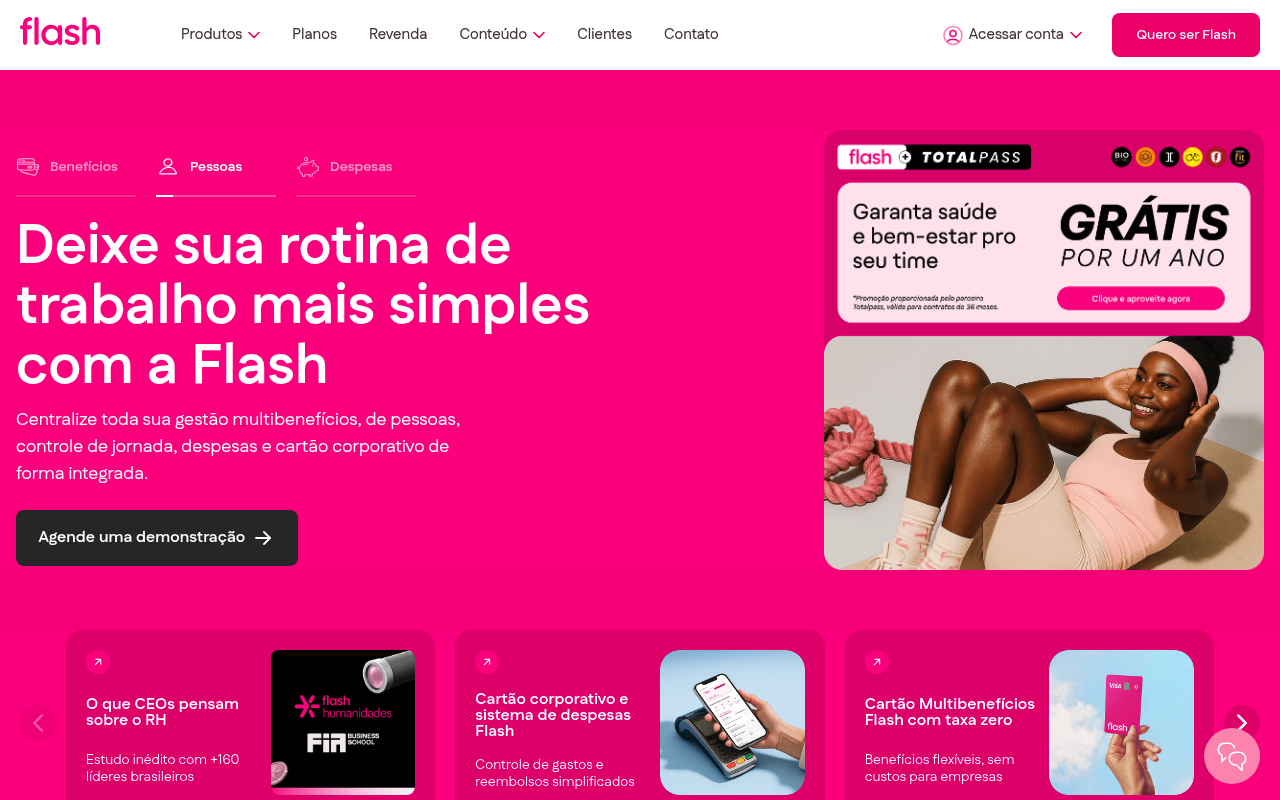
Flash (Flash Tecnologia) is a Sao Paulo based Brazilian HR and financial management platform that centralizes three surfaces on one account: multi-benefits (the Flash prepaid benefits card and PAT-compliant meal, food, mobility and wellness balances), people management (admissions and offboarding, time and attendance, recruiting, performance and engagement, extended by its FolhaCerta acquisition), and corporate expense management (corporate cards, receipt capture and reimbursement, from its 2022 ExpenseON acquisition). Founded by Ricardo Salem, Pedro Lane and Guilherme Lane, it launched in 2019 and reports more than 60,000 client companies, 1.5 million users and over R$10 billion in processed transactions. Its public developer surface is small: a ReadMe-hosted API reference covering the Flash Expense integration API (login and user provisioning against the expenseon.com hosts), with the Flash Beneficios reference still an unfilled template.
Real signal across most facets with visible, nameable gaps — the contract exists but is thin, or the portal is good while governance and commercial terms are absent.

API Evangelist profiles Flash App the way a machine reads it — 5 machine-readable artifacts across 2 APIs, pulled from the provider's own public surface and indexed so a developer, an analyst, or an AI agent can evaluate it against every other provider on the network.
Every provider in the network is reduced to the same set of machine-readable artifacts — OpenAPI contracts, event specifications, GraphQL schemas, runnable collections, pricing and rate-limit signals, security posture, OAuth scopes, and the agent surfaces (MCP servers and skills) that let software drive the API on its own. We profile them because the interface is the part of a company you can actually inspect: it is a truer signal of what a provider does than any marketing page. From those artifacts we compute the Kin Score — Flash App scores 50.5/100 (developing), with a separate agent-readiness read of 55/100 (agent ready). The full breakdown is below, followed by every artifact we hold — each card links through to its machine-readable definition on apis.io.
Kin Score
This is the API Evangelist rating — a single, repeatable read computed from the artifacts on this page. Green fill is points earned; the red track is points possible, so every bar shows earned-versus-possible at a glance.
Kin Score
How this is scored →scored 2026-07-27 · rubric v0.5
How we profile Flash App
Each block below is one kind of artifact we hold for Flash App. For each we say what it is and why it earns a place in the profile, then list every one we've indexed — capped at two rows, scroll within the panel for the rest.
APIs 2
Each API is captured as its own OpenAPI definition — every operation, parameter, and response. This is the single most useful machine-readable description of what an API does, and it's what lets us score, lint, mock, and generate against it without asking the provider for anything.
Individual APIs this provider publishes, each with its own machine-readable definition.
Flash App Integration API
The Integration API from Flash App — 1 operation(s) for integration.
Flash App Login API
The Login API from Flash App — 1 operation(s) for login.
MCP Servers 1
Model Context Protocol servers expose these APIs directly to AI agents. We profile them because agent-native access is the fastest-growing way this provider's capabilities actually get used.
Model Context Protocol servers that expose these APIs to AI agents.
flash-app-mcp.yml
MCP SERVERSecurity Posture 2
Authentication, domain security, vulnerability disclosure, and trust-center signals — the evidence that a provider takes security seriously enough to document it. We profile it because you can't govern what you can't see.
Authentication, domain security, vulnerability disclosure, and trust-center signals.
Resources
Every other property we hold for Flash App — documentation, portals, status pages, policies, and corporate surface — grouped by the job it does, following the integrator's arc from getting started to running in production.
Get Started 5
Portal, sign-up, and the first successful call
Documentation 2
Reference material describing how the API behaves
Agent Surfaces 4
MCP servers, agent skills, and machine-readable catalogs
Design & Contract 5
Pagination, idempotency, versioning, errors, and events
Build 1
SDKs, sample code, and the tooling you integrate with
Access & Security 4
Authentication, authorization, and security posture
Operate 3
Status, limits, changes, and where to get help
Commercial 2
Pricing, plans, and the legal terms of use
Company 2
The organization behind the API
← All providers · Data indexed from github.com/api-evangelist/flash-app · machine-readable index on apis.io