
Glass Health
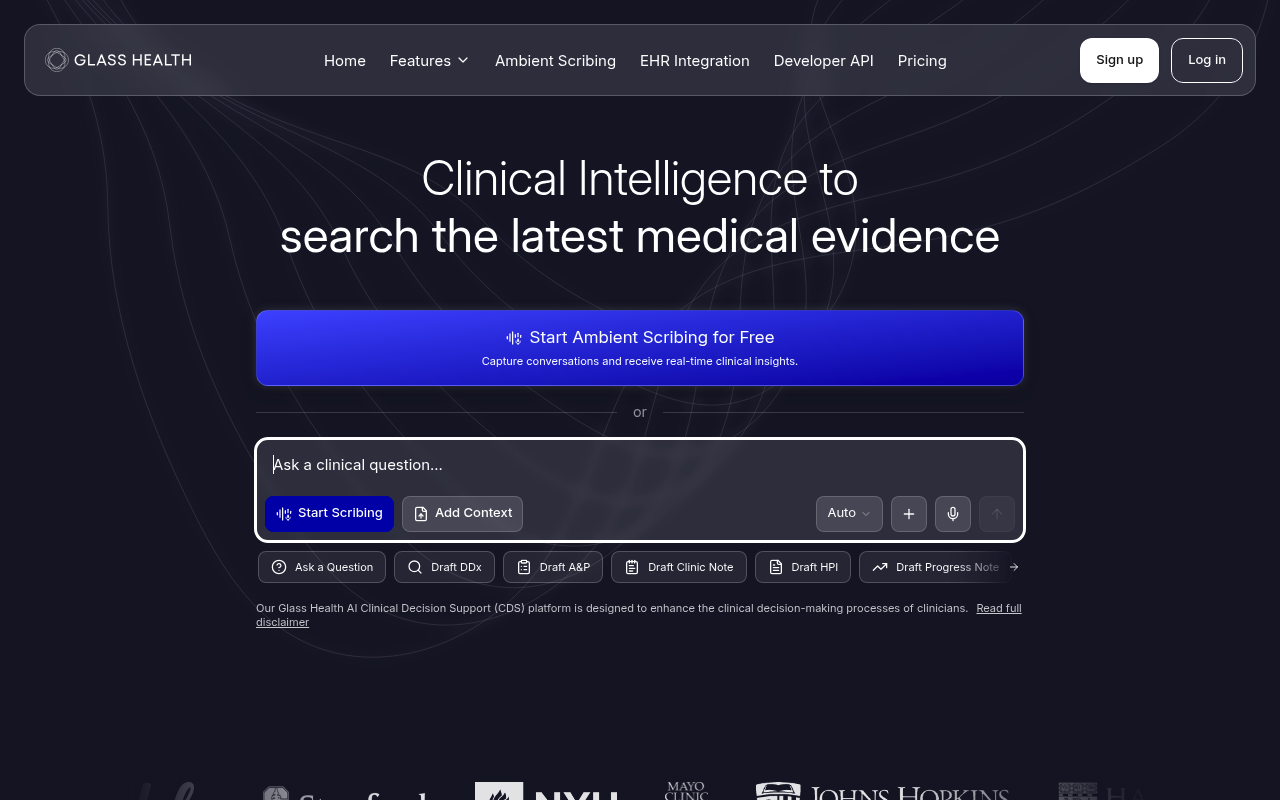
Glass Health is a San Francisco-based clinical AI company founded in 2021 by Dereck Paul (CEO) and Graham Ramsey (Head of Product) that builds an AI clinical decision support (CDS) and ambient scribing co-pilot for physicians, nurse practitioners, physician assistants, residents, and medical students. The Glass platform combines large language model reasoning with curated, physician-reviewed clinical guidelines to generate ranked differential diagnoses, evidence-based assessment and plans, chart summaries, and direct answers to clinical questions ("Consult"), all delivered with inline citations. Glass also provides ambient scribing that listens during patient encounters and generates History and Physical notes, progress notes, discharge summaries, and patient-facing instructions, plus EHR integration via SMART on FHIR to pull demographics, problem lists, medications, laboratory values, vital signs, imaging, and encounter data into the workflow. Glass offers a tiered SaaS plan (Lite free tier, Starter at $20/month, Pro at $90/month, Max at $200/month) along with iOS and Android apps, and a public Glass Developer API ($250/month minimum, token-metered beyond the floor) that exposes the same clinical AI agent — Consult, Differential Diagnosis, Assessment and Plan, and Scribing endpoints — for third-party healthcare products. Glass is backed by Breyer Capital and graduated from Y Combinator's W23 batch, with roughly $6.5M in total disclosed funding. The provider does not publish an open OpenAPI specification or open-source SDKs; integration details are gated behind the developer portal and an enterprise contact at enterprise@glass.health.
More than an index entry, but the surface is still mostly links rather than artifacts — the cohort most likely to move a full band from modest, well-targeted work.

API Evangelist profiles Glass Health the way a machine reads it — 21 machine-readable artifacts, pulled from the provider's own public surface and indexed so a developer, an analyst, or an AI agent can evaluate it against every other provider on the network.
Every provider in the network is reduced to the same set of machine-readable artifacts — OpenAPI contracts, event specifications, GraphQL schemas, runnable collections, pricing and rate-limit signals, security posture, OAuth scopes, and the agent surfaces (MCP servers and skills) that let software drive the API on its own. We profile them because the interface is the part of a company you can actually inspect: it is a truer signal of what a provider does than any marketing page. From those artifacts we compute the Kin Score — Glass Health scores 11.8/100 (emerging), with a separate agent-readiness read of 0/100 (human only). The full breakdown is below, followed by every artifact we hold — each card links through to its machine-readable definition on apis.io.
Kin Score
This is the API Evangelist rating — a single, repeatable read computed from the artifacts on this page. Green fill is points earned; the red track is points possible, so every bar shows earned-versus-possible at a glance. Every facet and dimension name is a link: it opens that measurement's page on APIs.io, where the rating runs across the whole catalog — the exact checks that feed it, how every profiled provider distributes on it, and who is at the top of it.
Kin Score
How this is scored →scored 2026-10-17 · rubric v0.24.0

Put this on your own site. The badge is drawn live from Glass Health's current Kin Score — paste it once and it updates itself every time the score is recomputed. It follows your visitor's light or dark setting, and it links back here so anyone who sees it can read the full breakdown.
<!-- Kin Score · API Evangelist -->
<a href="https://providers.apievangelist.com/providers/glass-health/"
   title="Glass Health on API Evangelist — API profile and Kin Score">
  <img src="https://apis.io/badge/glass-health.svg"
       alt="Glass Health Kin Score — API readiness rating by API Evangelist" width="150" height="150" loading="lazy">
</a>[](https://providers.apievangelist.com/providers/glass-health/)<!-- Kin Score · API Evangelist -->
<a href="https://providers.apievangelist.com/providers/glass-health/"
title="Glass Health on API Evangelist — API profile and Kin Score">
<img src="https://apis.io/badge/glass-health/card.svg"
alt="Glass Health Kin Score — API readiness rating by API Evangelist" width="340" height="120" loading="lazy">
</a>More shapes, themes and sizes → · Score as JSON · How badges work
How we profile Glass Health
Each block below is one kind of artifact we hold for Glass Health. For each we say what it is and why it earns a place in the profile, then list every one we've indexed — capped at two rows, scroll within the panel for the rest.
Features 9
The notable capabilities this provider advertises, captured as structured features so they can be searched and compared instead of read one landing page at a time.
Notable capabilities this provider offers.
Consult
Returns a direct, evidence-grounded answer to a clinical question with inline citations and organized context.
Differential Diagnosis
Generates a structured, ranked differential diagnosis with case discussion and recommended diagnostic next steps from a patient one-liner or chief complaint.
Assessment and Plan
Drafts clinical-grade assessment-and-plan documentation with synthesized impressions and evidence-linked recommendations.
Chart Summarization
AI synthesis of EHR data across notes, labs, imaging, and medications into a clinician-ready summary.
Ambient Scribing
Real-time diagnostic insights during the patient encounter plus automatic generation of comprehensive clinical documentation afterward.
Clinical Documentation
Generates History and Physical notes, progress notes with interval changes and vital signs, discharge summaries with disposition planning, and patient-facing discharge instructi...
Deep Reasoning
Enhanced reasoning mode for complex, high-stakes, or ambiguous clinical questions.
Workspace
Unified dashboard with file tabs, inline editing, and version history across clinical artifacts.
Mobile Apps
Native iOS and Android Glass Health applications for clinicians on the go.
Scroll within the panel for all 9 ·
Security Posture 1
Authentication, domain security, vulnerability disclosure, and trust-center signals — the evidence that a provider takes security seriously enough to document it. We profile it because you can't govern what you can't see.
Authentication, domain security, vulnerability disclosure, and trust-center signals.
Use Cases 7
What developers actually build with this provider — captured so the catalogue answers 'what is this for', not just 'what does this expose'.
What developers build with this provider.
Triage and Differential Diagnosis
Generating ranked differentials at the point of triage or initial workup to surface diagnoses worth considering.
Treatment Planning
Producing evidence-linked treatment options and assessment-and-plan drafts for clinician review.
Clinical Question Answering
Answering bedside clinical questions with citations to current medical literature.
Patient Record Summarization
Synthesizing longitudinal EHR data into a coherent patient summary.
Ambient Documentation
Capturing patient-clinician encounters in real time and producing structured notes without manual scribing.
Patient Education
Generating plain-language discharge instructions and condition-specific handouts.
Medical Education
Supporting medical students, residents, and fellows in case-based clinical reasoning practice.
Scroll within the panel for all 7 ·
Integrations 4
Pre-built integrations with other platforms tell you where this provider already fits in a stack.
Pre-built integrations with other platforms and tools.
SMART On FHIR
Glass integrates directly into EHR workflows via SMART on FHIR, surfacing the clinical AI inside the EHR interface.
EHR Data Elements
Pulls demographics, past medical history, problem lists, medications, surgical history, laboratory values, vital signs, imaging studies, functional status, social history, aller...
iOS
Native Glass Health app on the Apple App Store.
Android
Native Glass Health app on Google Play.
Resources
Every other property we hold for Glass Health — documentation, portals, status pages, policies, and corporate surface — grouped by the job it does, following the integrator's arc from getting started to running in production.
Get Started 2
Portal, sign-up, and the first successful call
Documentation 1
Reference material describing how the API behaves
Build 2
SDKs, sample code, and the tooling you integrate with
Access & Security 2
Authentication, authorization, and security posture
Operate 1
Status, limits, changes, and where to get help
Commercial 4
Pricing, plans, and the legal terms of use
Company 5
The organization behind the API
Other 11
Properties that don't map to a standard resource type
Scroll within the panel for all 11 ·
← All providers · Data indexed from github.com/api-evangelist/glass-health · machine-readable index on apis.io
This is an independent, third-party profile of Glass Health, published by API Evangelist. We do not operate, host, resell, or support these APIs, and we are not affiliated with or endorsed by the company unless stated above. Everything here is built from publicly available information — the company's own site, developer portal, documentation, public repositories, and the specifications it publishes for public use. Nothing is obtained by breaching a system, defeating an access control, or using credentials.
The Kin Score and Agent Readiness rating are independently calculated assessments of a company's public API artifacts, scored against a published rubric. They are not certifications, endorsements, security assessments, or audits.
Corrections, re-scores, and removal are free — no partnership or purchase required, and you do not need to justify the request. A removed company is recorded as unrated, never scored zero for having asked. Acknowledgement within one business day; removal within two.
info@apievangelist.com
·
Read the full data-sourcing policy →
On a security or compliance team? Put security in the subject line and
you will get a person, not a form — we will tell you exactly which public URLs this profile was built from.