
Kubernetes
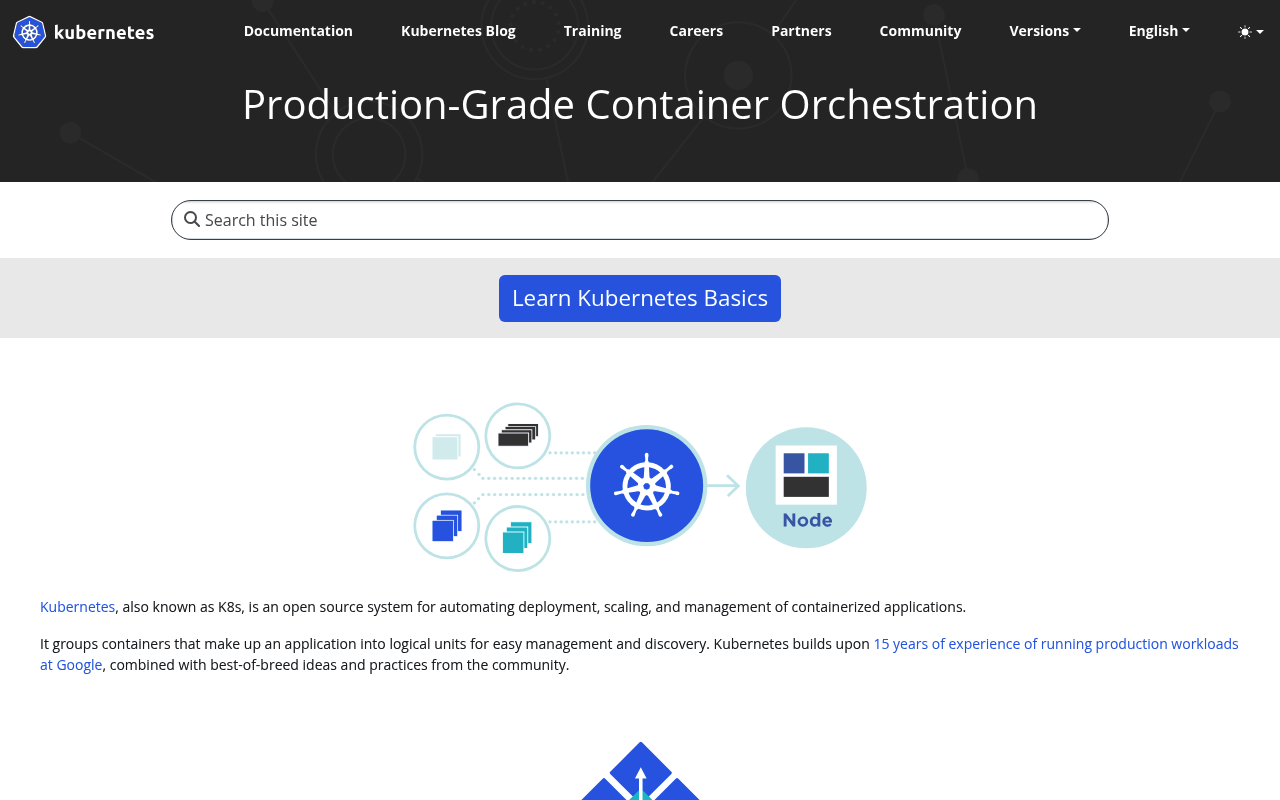
Kubernetes, also known as K8s, is an open source system for automating deployment, scaling, and management of containerized applications. It groups containers that make up an application into logical units for easy management and discovery. Kubernetes builds upon 15 years of experience of running production workloads at Google, combined with best-of-breed ideas and practices from the community.
Real signal across most facets with visible, nameable gaps — the contract exists but is thin, or the portal is good while governance and commercial terms are absent.

API Evangelist profiles Kubernetes the way a machine reads it — 51 machine-readable artifacts across 1 API, pulled from the provider's own public surface and indexed so a developer, an analyst, or an AI agent can evaluate it against every other provider on the network.
Every provider in the network is reduced to the same set of machine-readable artifacts — OpenAPI contracts, event specifications, GraphQL schemas, runnable collections, pricing and rate-limit signals, security posture, OAuth scopes, and the agent surfaces (MCP servers and skills) that let software drive the API on its own. We profile them because the interface is the part of a company you can actually inspect: it is a truer signal of what a provider does than any marketing page. From those artifacts we compute the Kin Score — Kubernetes scores 48.3/100 (developing), with a separate agent-readiness read of 24/100 (agent aware). The full breakdown is below, followed by every artifact we hold — each card links through to its machine-readable definition on apis.io.
Kin Score
This is the API Evangelist rating — a single, repeatable read computed from the artifacts on this page. Green fill is points earned; the red track is points possible, so every bar shows earned-versus-possible at a glance. Every facet and dimension name is a link: it opens that measurement's page on APIs.io, where the rating runs across the whole catalog — the exact checks that feed it, how every profiled provider distributes on it, and who is at the top of it.
Kin Score
How this is scored →scored 2026-10-17 · rubric v0.24.0

Put this on your own site. The badge is drawn live from Kubernetes's current Kin Score — paste it once and it updates itself every time the score is recomputed. It follows your visitor's light or dark setting, and it links back here so anyone who sees it can read the full breakdown.
<!-- Kin Score · API Evangelist -->
<a href="https://providers.apievangelist.com/providers/kubernetes/"
   title="Kubernetes on API Evangelist — API profile and Kin Score">
  <img src="https://apis.io/badge/kubernetes.svg"
       alt="Kubernetes Kin Score — API readiness rating by API Evangelist" width="150" height="150" loading="lazy">
</a>[](https://providers.apievangelist.com/providers/kubernetes/)<!-- Kin Score · API Evangelist -->
<a href="https://providers.apievangelist.com/providers/kubernetes/"
title="Kubernetes on API Evangelist — API profile and Kin Score">
<img src="https://apis.io/badge/kubernetes/card.svg"
alt="Kubernetes Kin Score — API readiness rating by API Evangelist" width="340" height="120" loading="lazy">
</a>More shapes, themes and sizes → · Score as JSON · How badges work
How we profile Kubernetes
Each block below is one kind of artifact we hold for Kubernetes. For each we say what it is and why it earns a place in the profile, then list every one we've indexed — capped at two rows, scroll within the panel for the rest.
APIs 7
Each API is captured as its own OpenAPI definition — every operation, parameter, and response. This is the single most useful machine-readable description of what an API does, and it's what lets us score, lint, mock, and generate against it without asking the provider for anything.
Individual APIs this provider publishes, each with its own machine-readable definition.
Kubernetes Autoscaling API
Autoscaling resources including HorizontalPodAutoscalers for automatically scaling workloads based on observed metrics.
Kubernetes Cluster API
Cluster-level resources including Namespaces, Nodes, ServiceAccounts, and RBAC resources for cluster administration.
Kubernetes Config API
Configuration and storage resources including ConfigMaps, Secrets, PersistentVolumes, and PersistentVolumeClaims.
Kubernetes Events API
Event resources capturing occurrences within the cluster such as pod scheduling, container restarts, and resource state changes.
Kubernetes Namespaces API
The Namespaces API from Kubernetes — 2 operation(s) for namespaces.
Kubernetes RBAC API
Role-based access control resources including Roles, RoleBindings, ClusterRoles, and ClusterRoleBindings for managing authorization.
Kubernetes Workloads API
Workload resources including Pods, Deployments, StatefulSets, DaemonSets, ReplicaSets, Jobs, and CronJobs for managing containerized applications.
Scroll within the panel for all 7 ·
Postman Collections 7
A runnable collection turns the contract into something a developer can execute in seconds. We profile them because the fastest way to trust an API is to make a real call against it.
Ready-to-run Postman collections for exercising this provider's APIs.
Kubernetes Autoscaling API
POSTMANScroll within the panel for all 7 ·
Open Collections 9
Open, tool-agnostic collections carry the same runnable value as Postman without locking you to one client — the portable, forkable form of the same exercise.
Open, tool-agnostic API collections (OpenAPI-derived and Bruno).
API Collection
OPEN COLLECTIONKubernetes API
OPEN COLLECTIONKubernetes Autoscaling API
OPEN COLLECTIONKubernetes Autoscaling Cluster API
OPEN COLLECTIONKubernetes Autoscaling Config API
OPEN COLLECTIONKubernetes Autoscaling Events API
OPEN COLLECTIONKubernetes Autoscaling Namespaces API
OPEN COLLECTIONKubernetes Autoscaling RBAC API
OPEN COLLECTIONKubernetes Autoscaling Workloads API
OPEN COLLECTIONScroll within the panel for all 9 ·
Arazzo Workflows 16
Real integrations are rarely a single call. Arazzo describes the multi-step sequences — auth, then create, then confirm — so both a human and an agent can follow the choreography, not just the endpoints.
Multi-step API workflows described with the Arazzo specification.
Kubernetes Attach a HorizontalPodAutoscaler to a Deployment
Confirm a deployment exists, create an HPA targeting it, and list the namespace's autoscalers.
ARAZZOKubernetes Audit Cluster Node Capacity
List the cluster's nodes, read one node's capacity and conditions in full, and enumerate namespaces.
ARAZZOKubernetes Publish a ConfigMap and Roll Out Its Consumers
Inventory existing ConfigMaps, publish the new configuration, then roll the deployment that reads it.
ARAZZOKubernetes Deploy an Application into a New Namespace
Create a namespace, seed its config and secrets, deploy the workload, and expose it behind a service.
ARAZZOKubernetes Expose a Deployment Behind a Service
Resolve a deployment, then create a fronting service or replace the existing one to match.
ARAZZOKubernetes Apply Governance Labels to a Namespace
Read a namespace, replace it carrying governance labels, and confirm the labels stuck.
ARAZZOKubernetes Provision a ClusterRole If Missing
Check whether a ClusterRole already exists and create it only when it does not.
ARAZZOKubernetes Quarantine a Failing Pod for Inspection
Relabel a misbehaving pod out of its service and ReplicaSet, then capture its logs while it stays alive.
ARAZZOKubernetes Restart a Pod by Deleting It
Confirm a pod is controller-owned, delete it gracefully, and watch the replacement appear.
ARAZZOKubernetes Retire an Application from a Namespace
Find an application's deployment, remove its service and deployment, and confirm the pods are gone.
ARAZZOKubernetes Roll Out a New Container Image
Read a deployment, replace it with an updated image, then watch the rollout and its events.
ARAZZOKubernetes Rotate a Secret and Restart Its Consumers
Inventory existing secrets, write the new credential, then roll the deployment that consumes it.
ARAZZOKubernetes Run a One-Off Task Pod and Collect Its Output
Create a run-to-completion pod, poll it until it finishes, read its log, then clean it up.
ARAZZOKubernetes Scale a Deployment and Verify Replicas
Read the current scale of a deployment, set a new replica count, and confirm the pods landed.
ARAZZOKubernetes Inventory and Tear Down a Namespace
Record what a namespace contains, delete the namespace, and confirm it entered Terminating.
ARAZZOKubernetes Troubleshoot a Failing Pod
Find pods that are not Running, read the failing pod's detail, tail its logs, and pull namespace events.
ARAZZOScroll within the panel for all 16 ·
Pricing Plans 1
Pricing is part of the interface. Machine-readable plans tell you what a tier costs and includes before you commit — one of the things the Kin Score reads for access clarity — renamed from commercial clarity in rubric 0.12, because a free statutory interface has access terms and no commercial ones.
Published pricing tiers and plan structures.
Rate Limits 1
Rate limits are the difference between a demo that works and a production integration that doesn't fall over. Publishing them is an operational-transparency signal — and a hard requirement for any agent that plans its own throughput.
Documented rate limits and quota policies.
Kubernetes Rate Limits
RATE LIMITSFinOps 1
Cost, billing, and metering signals let a buyer model the financial operations of an API before it's live. We profile them for the same reason we profile pricing: the money is part of the contract.
Cost, billing, and metering signals for API financial operations.
Kubernetes Finops
FINOPSEvent Specifications 1
Not every API is request/response. AsyncAPI describes the event-driven and streaming side — the webhooks and channels — so the asynchronous half of the interface is documented the same way the synchronous half is.
AsyncAPI definitions for this provider's event-driven and streaming APIs.
Kubernetes Watch Events
The Kubernetes Watch API provides a streaming event interface for receiving real-time notifications about changes to cluster resources. Clients subscribe to resource types and r...
ASYNCAPISemantic Vocabularies 1
JSON-LD contexts give the data shared meaning across APIs. We profile them because semantics are what let a machine reconcile 'customer' here with 'customer' somewhere else.
JSON-LD contexts and semantic vocabularies used across these APIs.
Kubernetes Context
JSON-LDSpectral Rules 2
Governance rulesets we run against this provider's specs — the automated checks behind parts of the score. Profiling them makes the quality bar explicit and re-runnable, not a matter of opinion.
Kubernetes — asyncapi rules
SPECTRALKubernetes — jsonschema rules
SPECTRALJSON Schema 1
Standalone JSON Schema definitions describe the data models behind the API. We profile them so the shapes are validatable on their own — useful long after a single request is forgotten.
Standalone JSON Schema definitions for this provider's data models.
Kubernetes Resource
JSON SCHEMASecurity Posture 3
Authentication, domain security, vulnerability disclosure, and trust-center signals — the evidence that a provider takes security seriously enough to document it. We profile it because you can't govern what you can't see.
Authentication, domain security, vulnerability disclosure, and trust-center signals.
Agentic Access 1
An x-agentic-access contract marks which operations are safe for an agent to run on its own and which need a human in the loop. It is the difference between an API an agent can use and one it can use safely.
Recommended x-agentic-access execution contracts for AI agents.
Resources
Every other property we hold for Kubernetes — documentation, portals, status pages, policies, and corporate surface — grouped by the job it does, following the integrator's arc from getting started to running in production.
Get Started 2
Portal, sign-up, and the first successful call
Documentation 3
Reference material describing how the API behaves
Agent Surfaces 4
MCP servers, agent skills, and machine-readable catalogs
Design & Contract 22
Pagination, idempotency, versioning, errors, and events
Scroll within the panel for all 22 ·
Build 8
SDKs, sample code, and the tooling you integrate with
Scroll within the panel for all 8 ·
Access & Security 5
Authentication, authorization, and security posture
Learn 3
Tutorials, courses, talks, and written guidance
Operate 8
Status, limits, changes, and where to get help
Scroll within the panel for all 8 ·
Commercial 3
Pricing, plans, and the legal terms of use
Company 6
The organization behind the API
Other 5
Properties that don't map to a standard resource type
← All providers · Data indexed from github.com/api-evangelist/kubernetes · machine-readable index on apis.io
This is an independent, third-party profile of Kubernetes, published by API Evangelist. We do not operate, host, resell, or support these APIs, and we are not affiliated with or endorsed by the company unless stated above. Everything here is built from publicly available information — the company's own site, developer portal, documentation, public repositories, and the specifications it publishes for public use. Nothing is obtained by breaching a system, defeating an access control, or using credentials.
The Kin Score and Agent Readiness rating are independently calculated assessments of a company's public API artifacts, scored against a published rubric. They are not certifications, endorsements, security assessments, or audits.
Corrections, re-scores, and removal are free — no partnership or purchase required, and you do not need to justify the request. A removed company is recorded as unrated, never scored zero for having asked. Acknowledgement within one business day; removal within two.
info@apievangelist.com
·
Read the full data-sourcing policy →
On a security or compliance team? Put security in the subject line and
you will get a person, not a form — we will tell you exactly which public URLs this profile was built from.