
OPay
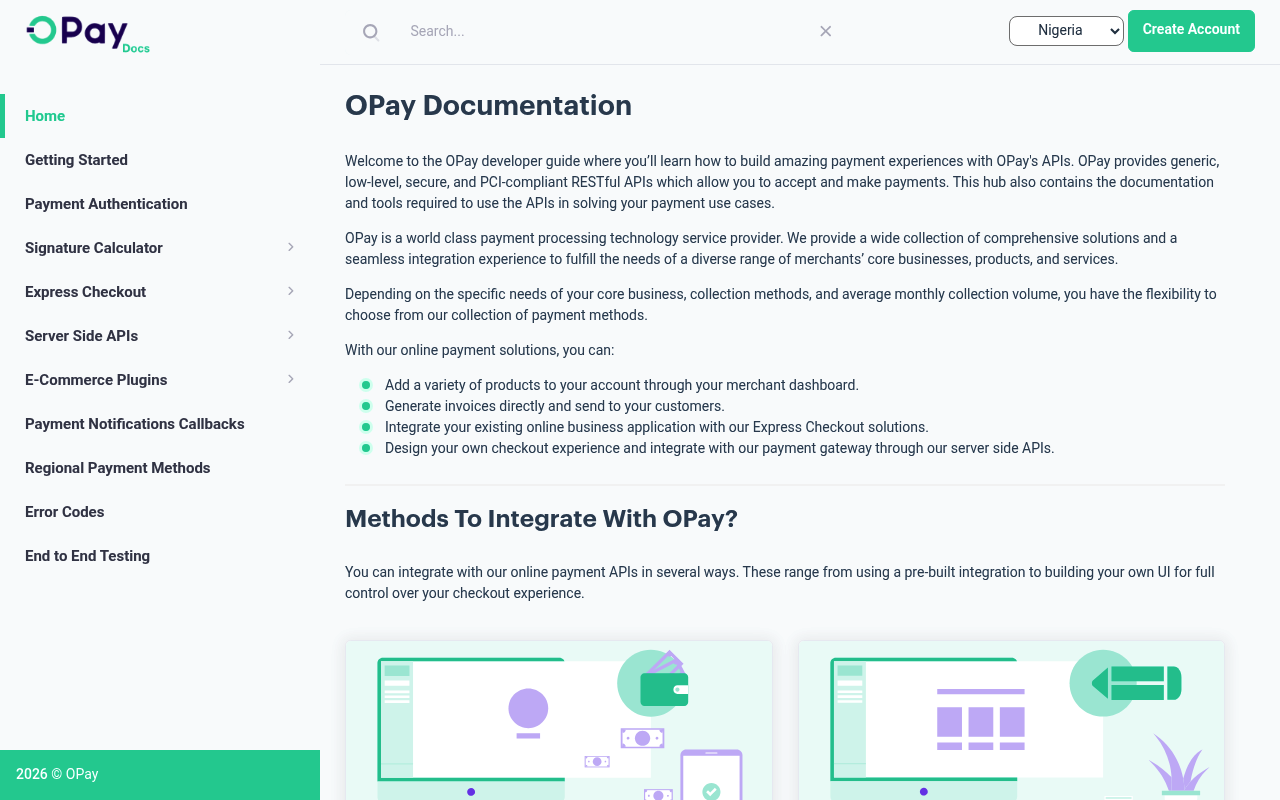
OPay is a Nigerian mobile money and fintech super-app operated by Blue Ridge Microfinance Bank (OPay Digital Services Limited) and majority-owned by Opera Limited with backing from SoftBank Vision Fund 2, Sequoia China, DragonBall Capital, and 9F Group. Launched in 2018 and headquartered in Lagos, OPay serves tens of millions of Nigerian consumers, merchants, and agents with wallet accounts, free interbank transfers, the OPay Debit Card, OWealth (daily-interest savings powered by OPay Microfinance Bank), bill payments, airtime/data top-ups, BNPL (OBuy / OPay Easy Buy), and the OPay POS / agent banking network. For developers and merchants, OPay exposes the OPay Cashier / OPay Checkout API — a REST API for accepting payments via 3DS bank cards, bank transfer, USSD, bank account, POS, OPay wallet QR, and reference codes, with hosted Express Checkout, server-to-server APIs, callback webhooks, refund and query operations, a PHP gateway SDK, and a WooCommerce plugin. Sandbox and production environments are available at testapi.opaycheckout.com and liveapi.opaycheckout.com, with HMAC-SHA512 signature authentication and per-merchant public/private key pairs issued from the OPay merchant dashboard.
Limited machine-readable signal and partial portal coverage — documentation a human can read, but little a machine or agent can consume without scraping.

API Evangelist profiles OPay the way a machine reads it — 46 machine-readable artifacts across 3 APIs, pulled from the provider's own public surface and indexed so a developer, an analyst, or an AI agent can evaluate it against every other provider on the network.
Every provider in the network is reduced to the same set of machine-readable artifacts — OpenAPI contracts, event specifications, GraphQL schemas, runnable collections, pricing and rate-limit signals, security posture, OAuth scopes, and the agent surfaces (MCP servers and skills) that let software drive the API on its own. We profile them because the interface is the part of a company you can actually inspect: it is a truer signal of what a provider does than any marketing page. From those artifacts we compute the Kin Score — OPay scores 33.0/100 (thin), with a separate agent-readiness read of 26/100 (agent aware). The full breakdown is below, followed by every artifact we hold — each card links through to its machine-readable definition on apis.io.
Kin Score
This is the API Evangelist rating — a single, repeatable read computed from the artifacts on this page. Green fill is points earned; the red track is points possible, so every bar shows earned-versus-possible at a glance. Every facet and dimension name is a link: it opens that measurement's page on APIs.io, where the rating runs across the whole catalog — the exact checks that feed it, how every profiled provider distributes on it, and who is at the top of it.
Kin Score
How this is scored →scored 2026-10-17 · rubric v0.24.0

Put this on your own site. The badge is drawn live from OPay's current Kin Score — paste it once and it updates itself every time the score is recomputed. It follows your visitor's light or dark setting, and it links back here so anyone who sees it can read the full breakdown.
<!-- Kin Score · API Evangelist -->
<a href="https://providers.apievangelist.com/providers/opay/"
   title="OPay on API Evangelist — API profile and Kin Score">
  <img src="https://apis.io/badge/opay.svg"
       alt="OPay Kin Score — API readiness rating by API Evangelist" width="150" height="150" loading="lazy">
</a>[](https://providers.apievangelist.com/providers/opay/)<!-- Kin Score · API Evangelist -->
<a href="https://providers.apievangelist.com/providers/opay/"
title="OPay on API Evangelist — API profile and Kin Score">
<img src="https://apis.io/badge/opay/card.svg"
alt="OPay Kin Score — API readiness rating by API Evangelist" width="340" height="120" loading="lazy">
</a>More shapes, themes and sizes → · Score as JSON · How badges work
How we profile OPay
Each block below is one kind of artifact we hold for OPay. For each we say what it is and why it earns a place in the profile, then list every one we've indexed — capped at two rows, scroll within the panel for the rest.
APIs 3
Each API is captured as its own OpenAPI definition — every operation, parameter, and response. This is the single most useful machine-readable description of what an API does, and it's what lets us score, lint, mock, and generate against it without asking the provider for anything.
Individual APIs this provider publishes, each with its own machine-readable definition.
OPay Cashier API
The OPay Cashier API is the primary merchant payment API behind OPay Checkout. It exposes a hosted Express Checkout endpoint (cashier/create returning a cashierUrl), server-to-s...
OPay Payments API
Server-to-server payment creation across payment methods.
OPay Refunds API
Refund creation and status.
Open Collections 4
Open, tool-agnostic collections carry the same runnable value as Postman without locking you to one client — the portable, forkable form of the same exercise.
Open, tool-agnostic API collections (OpenAPI-derived and Bruno).
API Collection
OPEN COLLECTIONOPay Cashier API
OPEN COLLECTIONOPay Cashier Payments API
OPEN COLLECTIONOPay Cashier Refunds API
OPEN COLLECTIONFeatures 15
The notable capabilities this provider advertises, captured as structured features so they can be searched and compared instead of read one landing page at a time.
Notable capabilities this provider offers.
Express Checkout
Hosted, OPay-branded checkout page returned via cashier/create — customers complete payment on OPay-managed UI and are redirected back to the merchant returnUrl.
3DS Card Payments
Direct server-to-server card acceptance with 3-D Secure step-up (REDIRECT_3DS nextAction) for Nigerian and international card schemes.
Bank Transfer
Generate a dynamic virtual account (transferAccountNumber + transferBankName) per order; OPay reconciles inbound transfer and settles the merchant.
Bank USSD Payment
Customer pays by dialling a *USSD* code on their mobile phone; common in Nigeria where USSD banking is dominant.
Bank Account Payment
Direct debit from the customer's bank account.
POS Payment
Card-present payment from an OPay POS terminal.
OPay Wallet QR Payment
Customer scans a QR code in the OPay app to pay from their wallet.
Reference Code Payment
Customer pays at an OPay agent using a reference code.
Refunds
Full or partial refunds with refund status query.
Payment Status Query
Synchronous query for order status by merchant reference or OPay orderNo.
Callback Webhooks
Server-to-server callback notifications on terminal transaction state changes (SUCCESS, FAIL, CLOSE), signed and retried by OPay.
HMAC-SHA512 Signature Authentication
All non-cashier-create endpoints authenticate via a SHA-512 HMAC signature over the JSON body using the merchant's private key, plus a MerchantId header.
Sandbox Environment
testapi.opaycheckout.com sandbox with trigger-error-by-amount testing.
WooCommerce Plugin
Drop-in WooCommerce plugin for WordPress storefronts.
PHP Gateway SDK
Official open-source PHP gateway library at github.com/opay/lib.gateway.php.
Scroll within the panel for all 15 ·
Security Posture 2
Authentication, domain security, vulnerability disclosure, and trust-center signals — the evidence that a provider takes security seriously enough to document it. We profile it because you can't govern what you can't see.
Authentication, domain security, vulnerability disclosure, and trust-center signals.
Agentic Access 1
An x-agentic-access contract marks which operations are safe for an agent to run on its own and which need a human in the loop. It is the difference between an API an agent can use and one it can use safely.
Recommended x-agentic-access execution contracts for AI agents.
Use Cases 8
What developers actually build with this provider — captured so the catalogue answers 'what is this for', not just 'what does this expose'.
What developers build with this provider.
Nigerian E-commerce Checkout
Accept local payment methods (card, bank transfer, USSD, OPay wallet) on Nigerian e-commerce sites via Express Checkout or server APIs.
Cross-Border Online Merchants
Sell into Nigeria from international storefronts via OPay International APIs.
Marketplace Payouts
Pay agents, riders, and sellers via OPay transfers.
Bill Payment & Airtime Aggregation
Top up airtime/data and pay utility bills from within partner apps.
Wallet Top-Up
Fund OPay wallets from cards or bank transfers.
Buy-Now-Pay-Later Checkout
Offer BNPL via OBuy / OPay Easy Buy at checkout.
Agent Banking & Cash-In/Cash-Out
Leverage the OPay agent network for cash deposits and withdrawals.
POS Acceptance
Card-present acceptance via OPay POS terminals.
Scroll within the panel for all 8 ·
Integrations 7
Pre-built integrations with other platforms tell you where this provider already fits in a stack.
Pre-built integrations with other platforms and tools.
WooCommerce
Official OPay WooCommerce plugin for WordPress.
Opera Browser
OPay was originally incubated inside Opera Limited and integrates with Opera browser payment flows.
Visa
Card acquiring on the Visa network.
Mastercard
Card acquiring on the Mastercard network.
Verve
Card acquiring on the Nigerian Verve network.
Nigerian Interbank Settlement System (NIBSS)
Bank transfer rails and USSD banking via NIBSS.
Wema Bank
Partner bank for virtual-account bank-transfer settlement (referenced in API responses).
Scroll within the panel for all 7 ·
Solutions 6
Packaged solutions the provider offers on top of the raw API surface.
Packaged solutions this provider offers.
OPay Personal App
Consumer super-app for wallet, transfers, OWealth savings, debit card, bill pay.
OPay Business
Merchant suite — Cashier API, POS terminals, agent banking, payouts.
OWealth
Daily-interest savings powered by OPay Microfinance Bank Limited (CBN licensed, NDIC insured).
OPay Debit Card
Instant-issuance debit card accepted on ATM, POS, and online.
OBuy / OPay Easy Buy
Buy-now-pay-later product for OPay app users.
OPay POS
POS terminal network for merchants and agents.
Resources
Every other property we hold for OPay — documentation, portals, status pages, policies, and corporate surface — grouped by the job it does, following the integrator's arc from getting started to running in production.
Get Started 5
Portal, sign-up, and the first successful call
Documentation 2
Reference material describing how the API behaves
Agent Surfaces 1
MCP servers, agent skills, and machine-readable catalogs
Design & Contract 2
Pagination, idempotency, versioning, errors, and events
Build 3
SDKs, sample code, and the tooling you integrate with
Access & Security 3
Authentication, authorization, and security posture
Learn 1
Tutorials, courses, talks, and written guidance
Operate 1
Status, limits, changes, and where to get help
Commercial 2
Pricing, plans, and the legal terms of use
Company 6
The organization behind the API
Other 5
Properties that don't map to a standard resource type
← All providers · Data indexed from github.com/api-evangelist/opay · machine-readable index on apis.io
This is an independent, third-party profile of OPay, published by API Evangelist. We do not operate, host, resell, or support these APIs, and we are not affiliated with or endorsed by the company unless stated above. Everything here is built from publicly available information — the company's own site, developer portal, documentation, public repositories, and the specifications it publishes for public use. Nothing is obtained by breaching a system, defeating an access control, or using credentials.
The Kin Score and Agent Readiness rating are independently calculated assessments of a company's public API artifacts, scored against a published rubric. They are not certifications, endorsements, security assessments, or audits.
Corrections, re-scores, and removal are free — no partnership or purchase required, and you do not need to justify the request. A removed company is recorded as unrated, never scored zero for having asked. Acknowledgement within one business day; removal within two.
info@apievangelist.com
·
Read the full data-sourcing policy →
On a security or compliance team? Put security in the subject line and
you will get a person, not a form — we will tell you exactly which public URLs this profile was built from.