
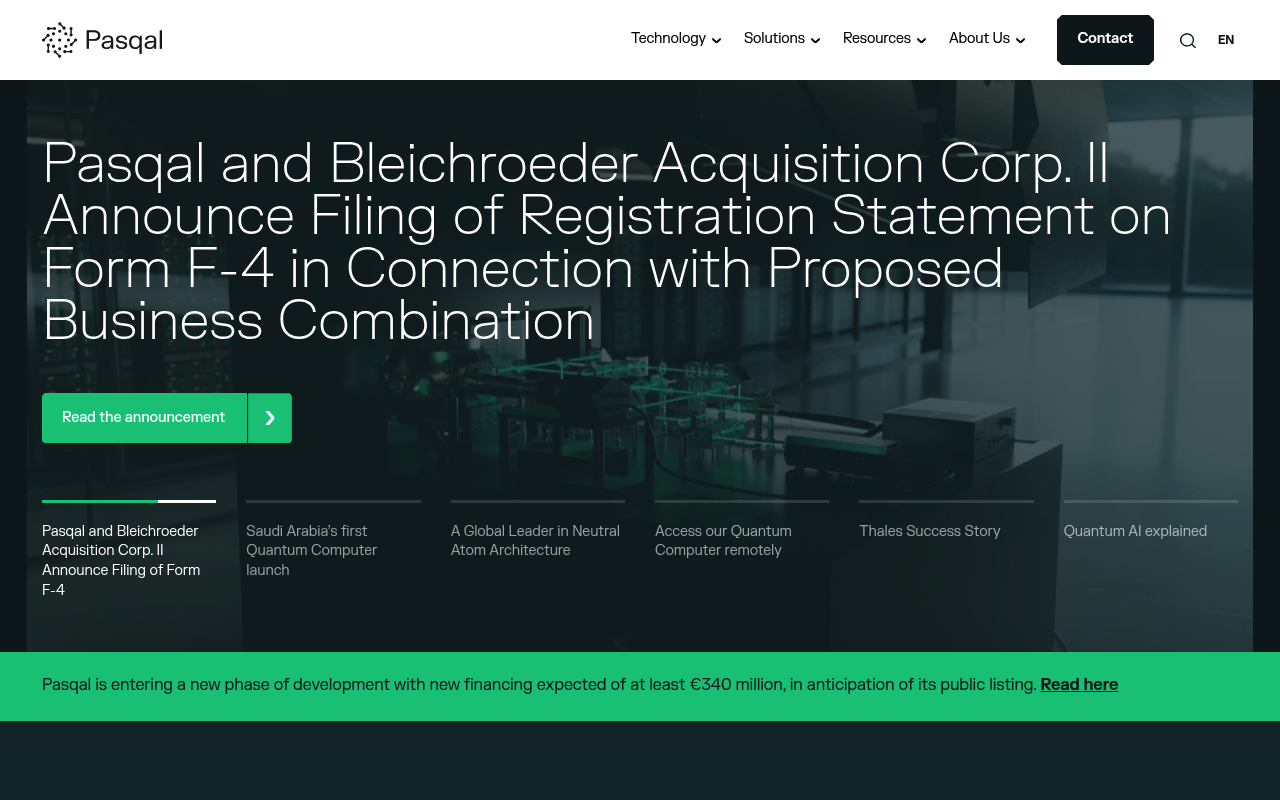
Pasqal
Pasqal is a French neutral-atom quantum computing company headquartered in Palaiseau, France and co-founded in 2019 by 2022 Physics Nobel Laureate Alain Aspect. Pasqal builds commercial-grade neutral-atom quantum processors (the Fresnel QPU family) that use arrays of laser-trapped Rydberg atoms to run both analog and digital quantum programs, and packages them as on-premise systems and as Pasqal Cloud Services — a pay-as-you-go quantum computing platform also distributed through Google Cloud, Microsoft Azure Quantum, OVHcloud, and AWS partners. The developer surface is anchored by Pulser, the open-source (Apache-2.0) Python library for pulse-level/analog programming of neutral-atom devices, the pasqal-cloud Python SDK for submitting Pulser sequences and workloads to QPUs and emulators, and the Pasqal Cloud Services REST API (with Auth0-based authentication and v1/v2 endpoints for batches, jobs, devices, workloads, projects, members, billing, and OVH integrations). The broader ecosystem includes Qadence (digital-analog programming), Pulser Studio (no-code visual programming), the EMU-MPS and EMU-SV GPU-accelerated emulators, and quantum application libraries — QEK (Quantum Evolution Kernel for graph ML), QUBO-Solver, Maximum-Independent-Set, and QoolQit (Rydberg analog algorithm development). Pasqal serves 35+ commercial engagements across energy, finance, logistics, automotive, and pharma — including BMW, Thales, Capgemini, Sumitomo, Aramco, CMA CGM, and KAIST — and partners with NVIDIA (CUDA-Q), IBM, Google, and Microsoft. In May 2026 Pasqal demonstrated logical qubits outperforming physical qubits on differential equations, and in March 2026 announced 340M+ euros of new financing ahead of going public via business combination with Bleichroeder Acquisition Corp II.
More than an index entry, but the surface is still mostly links rather than artifacts — the cohort most likely to move a full band from modest, well-targeted work.

API Evangelist profiles Pasqal the way a machine reads it — 45 machine-readable artifacts across 8 APIs, pulled from the provider's own public surface and indexed so a developer, an analyst, or an AI agent can evaluate it against every other provider on the network.
Every provider in the network is reduced to the same set of machine-readable artifacts — OpenAPI contracts, event specifications, GraphQL schemas, runnable collections, pricing and rate-limit signals, security posture, OAuth scopes, and the agent surfaces (MCP servers and skills) that let software drive the API on its own. We profile them because the interface is the part of a company you can actually inspect: it is a truer signal of what a provider does than any marketing page. From those artifacts we compute the Kin Score — Pasqal scores 18.8/100 (emerging), with a separate agent-readiness read of 3/100 (human only). The full breakdown is below, followed by every artifact we hold — each card links through to its machine-readable definition on apis.io.
Kin Score
This is the API Evangelist rating — a single, repeatable read computed from the artifacts on this page. Green fill is points earned; the red track is points possible, so every bar shows earned-versus-possible at a glance. Every facet and dimension name is a link: it opens that measurement's page on APIs.io, where the rating runs across the whole catalog — the exact checks that feed it, how every profiled provider distributes on it, and who is at the top of it.
Kin Score
How this is scored →scored 2026-10-17 · rubric v0.24.0

Put this on your own site. The badge is drawn live from Pasqal's current Kin Score — paste it once and it updates itself every time the score is recomputed. It follows your visitor's light or dark setting, and it links back here so anyone who sees it can read the full breakdown.
<!-- Kin Score · API Evangelist -->
<a href="https://providers.apievangelist.com/providers/pasqal/"
   title="Pasqal on API Evangelist — API profile and Kin Score">
  <img src="https://apis.io/badge/pasqal.svg"
       alt="Pasqal Kin Score — API readiness rating by API Evangelist" width="150" height="150" loading="lazy">
</a>[](https://providers.apievangelist.com/providers/pasqal/)<!-- Kin Score · API Evangelist -->
<a href="https://providers.apievangelist.com/providers/pasqal/"
title="Pasqal on API Evangelist — API profile and Kin Score">
<img src="https://apis.io/badge/pasqal/card.svg"
alt="Pasqal Kin Score — API readiness rating by API Evangelist" width="340" height="120" loading="lazy">
</a>More shapes, themes and sizes → · Score as JSON · How badges work
How we profile Pasqal
Each block below is one kind of artifact we hold for Pasqal. For each we say what it is and why it earns a place in the profile, then list every one we've indexed — capped at two rows, scroll within the panel for the rest.
APIs 8
Each API is captured as its own OpenAPI definition — every operation, parameter, and response. This is the single most useful machine-readable description of what an API does, and it's what lets us score, lint, mock, and generate against it without asking the provider for anything.
Individual APIs this provider publishes, each with its own machine-readable definition.
Pasqal Cloud Services API
REST API for Pasqal Cloud Services — submit and manage quantum Batches and Jobs on Pasqal Fresnel QPUs and on emulator backends (EMU-FREE, EMU-TN, EMU-MPS, EMU-SV), query Device...
Pulser SDK
Pulser is Pasqal's open-source (Apache-2.0) Python framework for composing, simulating, and executing pulse sequences on neutral-atom quantum devices. It supports both digital q...
Qadence SDK
Qadence is Pasqal's higher-level digital-analog quantum programming interface for writing variational quantum programs with tunable qubit interactions, designed for neutral-atom...
Quantum Evolution Kernel (QEK)
QEK is Pasqal's open-source graph machine learning library that uses quantum-driven similarity metrics derived from neutral-atom dynamics to build graph kernels for classificati...
QUBO Solver
Quadratic Unconstrained Binary Optimization solver library that combines classical heuristics with quantum and quantum-inspired approaches running on Pasqal neutral-atom hardwar...
Maximum Independent Set Solver
Maximum Independent Set (MIS) solver library that exploits the natural mapping of MIS onto Rydberg-blockade dynamics of neutral-atom QPUs, with quantum and classical baselines f...
QoolQit SDK
QoolQit is Pasqal's Python package for simplified algorithm development in the Rydberg Analog Model on neutral-atom hardware, providing a more approachable layer above Pulser fo...
Pasqal Emulators (EMU-MPS, EMU-SV)
Pasqal's PyTorch-based GPU-accelerated emulator monorepo housing EMU-MPS (matrix-product-state emulator for 60-100 qubits) and EMU-SV (high-precision state-vector emulator) for ...
Scroll within the panel for all 8 ·
Features 16
The notable capabilities this provider advertises, captured as structured features so they can be searched and compared instead of read one landing page at a time.
Notable capabilities this provider offers.
Fresnel QPU
Pasqal's commercial neutral-atom quantum processor based on arrays of laser-trapped Rydberg atoms, scaling toward 1000+ atoms.
Dual analog and digital quantum computing
Single neutral-atom architecture supports both analog Hamiltonian simulation and digital gate-based programs.
Pulser open-source SDK
Apache-2.0 Python library for composing, simulating, and executing pulse sequences on neutral-atom hardware.
Pasqal Cloud Services REST API
REST API for batches, jobs, workloads, devices, projects, members, and billing with Auth0 authentication.
pasqal-cloud Python SDK
Python SDK wrapping the Cloud Services REST API for submitting Pulser sequences to QPUs and emulators.
Qadence digital-analog interface
Higher-level digital-analog programming interface with PyTorch (pyqtorch) and JAX (horqrux) backends.
Pulser Studio no-code platform
Visual programming environment for designing neutral-atom quantum programs without writing code.
EMU-MPS and EMU-SV emulators
GPU-accelerated emulators for 60-100 qubit neutral-atom dynamics simulation, available locally and on Pasqal Cloud.
Quantum Evolution Kernel (QEK)
Open-source graph machine learning library using quantum-driven graph similarity metrics.
QUBO and MIS application libraries
Open-source optimization libraries mapping QUBO and Maximum Independent Set problems onto Rydberg-blockade dynamics.
Auth0 authentication
Cloud Services authentication via username/password, token-provider, or Auth0TokenProvider with refreshing token support.
Credits-based billing
Credit Pools and Monthly Credit Consumption endpoints support a pay-as-you-go credits billing model on Pasqal Cloud Services.
NVIDIA CUDA-Q integration
Hybrid quantum-HPC integration with NVIDIA CUDA-Q for accelerated quantum-classical workflows.
Multi-cloud distribution
Pasqal QPUs and emulators distributed through Google Cloud, Microsoft Azure Quantum, OVHcloud, and AWS partners.
On-premise deployment option
Commercial-grade neutral-atom quantum computers available for on-site deployment at customer facilities.
Logical qubits demonstration
May 2026 industry-first demonstration of neutral-atom logical qubits outperforming physical qubits on differential equations.
Scroll within the panel for all 16 ·
Security Posture 1
Authentication, domain security, vulnerability disclosure, and trust-center signals — the evidence that a provider takes security seriously enough to document it. We profile it because you can't govern what you can't see.
Authentication, domain security, vulnerability disclosure, and trust-center signals.
Use Cases 8
What developers actually build with this provider — captured so the catalogue answers 'what is this for', not just 'what does this expose'.
What developers build with this provider.
Combinatorial optimization
QUBO and MIS-based optimization for logistics, smart charging, routing, and scheduling on neutral-atom hardware.
Quantum machine learning
Graph kernels and variational quantum models for classification, regression, and generative tasks via QEK and Qadence.
Quantum chemistry and materials
Analog Hamiltonian simulation of strongly correlated systems and materials discovery workloads.
Drug discovery and molecular docking
Neutral-atom QPUs applied to molecular docking and protein design (e.g., partnership with True Nexus).
Finance and risk modeling
Portfolio optimization and risk analytics on neutral-atom hardware via partner deployments.
Smart charging and energy optimization
QAOA-tailored approaches for electric-vehicle smart-charging and grid optimization.
Quantum-enhanced HPC
Hybrid quantum-classical workloads bridging Pasqal QPUs and supercomputing centers (CINECA, GENCI).
Space mission optimization
QUBO-formulated space mission optimization (smo-qubo) on neutral-atom backends.
Scroll within the panel for all 8 ·
Integrations 8
Pre-built integrations with other platforms tell you where this provider already fits in a stack.
Pre-built integrations with other platforms and tools.
NVIDIA CUDA-Q
Pasqal-NVIDIA integration enabling hybrid quantum-HPC environments via CUDA-Q.
Microsoft Azure Quantum
pulser-azure provider exposes Pasqal QPUs via Azure Quantum.
Google Cloud Marketplace
Pasqal Cloud Services available through Google Cloud partnerships.
AWS / IBM partnerships
Pasqal partners with IBM and is reachable via AWS distribution channels for enterprise quantum workloads.
OVHcloud
Pulser-OVH tutorials and integration for European sovereign quantum cloud access.
Atos / Eviden myQLM
Pulser-myQLM integration for the Atos/Eviden myQLM quantum programming framework.
CINECA / GENCI / EuroHPC
Pasqal QPUs integrated into European supercomputing centers for hybrid HPC-quantum workloads.
Aramco
Saudi Aramco partnership delivering the Middle East's first commercial quantum computing service platform.
Scroll within the panel for all 8 ·
Solutions 4
Packaged solutions the provider offers on top of the raw API surface.
Packaged solutions this provider offers.
Pasqal Cloud Services
Pay-as-you-go cloud access to Pasqal Fresnel QPUs and emulator backends via REST API and Python SDK.
On-premise quantum computers
Commercial-grade neutral-atom quantum computers delivered for on-site customer deployment.
Pulser Studio
No-code visual environment for authoring neutral-atom quantum programs.
Quantum application libraries
Vertical solution libraries — QEK, QUBO-Solver, MIS, smo-qubo, Molecular-Docking — built on Pulser and Qadence.
Resources
Every other property we hold for Pasqal — documentation, portals, status pages, policies, and corporate surface — grouped by the job it does, following the integrator's arc from getting started to running in production.
Get Started 5
Portal, sign-up, and the first successful call
Documentation 2
Reference material describing how the API behaves
Build 14
SDKs, sample code, and the tooling you integrate with
Scroll within the panel for all 14 ·
Access & Security 2
Authentication, authorization, and security posture
Learn 2
Tutorials, courses, talks, and written guidance
Operate 2
Status, limits, changes, and where to get help
Commercial 3
Pricing, plans, and the legal terms of use
Company 6
The organization behind the API
← All providers · Data indexed from github.com/api-evangelist/pasqal · machine-readable index on apis.io
This is an independent, third-party profile of Pasqal, published by API Evangelist. We do not operate, host, resell, or support these APIs, and we are not affiliated with or endorsed by the company unless stated above. Everything here is built from publicly available information — the company's own site, developer portal, documentation, public repositories, and the specifications it publishes for public use. Nothing is obtained by breaching a system, defeating an access control, or using credentials.
The Kin Score and Agent Readiness rating are independently calculated assessments of a company's public API artifacts, scored against a published rubric. They are not certifications, endorsements, security assessments, or audits.
Corrections, re-scores, and removal are free — no partnership or purchase required, and you do not need to justify the request. A removed company is recorded as unrated, never scored zero for having asked. Acknowledgement within one business day; removal within two.
info@apievangelist.com
·
Read the full data-sourcing policy →
On a security or compliance team? Put security in the subject line and
you will get a person, not a form — we will tell you exactly which public URLs this profile was built from.