
PokéAPI
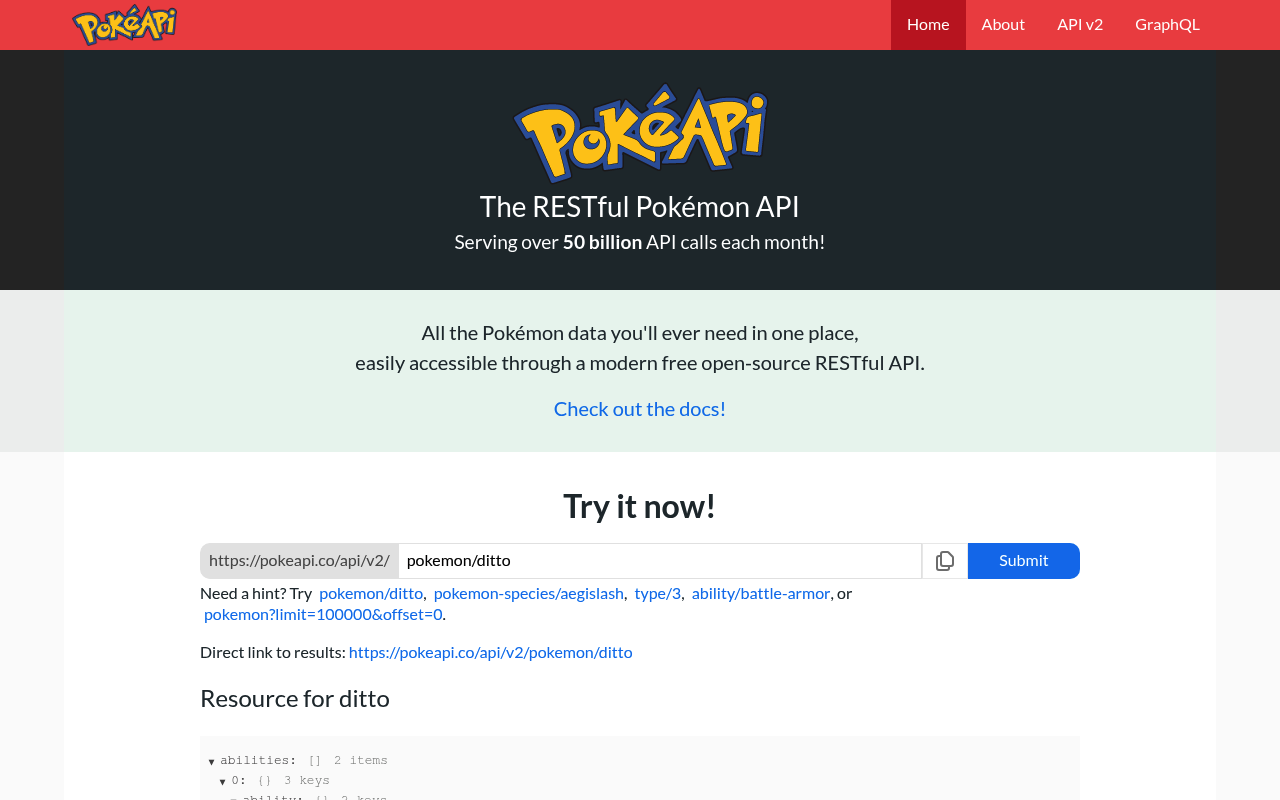
PokéAPI (pokeapi.co) is a free, open-source RESTful and GraphQL API serving comprehensive Pokémon data — including Pokémon species, abilities, moves, items, types, locations, evolution chains, encounters, berries, contests, games, and machines. Built as an educational tool licensed under BSD-3-Clause, it is community-funded via Open Collective and GitHub Sponsors, requires no authentication, and is hosted with a fair-use policy encouraging clients to cache responses locally. The API powers tutorials, fan apps, machine-learning experiments, and game tooling worldwide and consistently serves one billion-plus requests per month.
Real signal across most facets with visible, nameable gaps — the contract exists but is thin, or the portal is good while governance and commercial terms are absent.

API Evangelist profiles PokéAPI the way a machine reads it — 217 machine-readable artifacts across 1 API, pulled from the provider's own public surface and indexed so a developer, an analyst, or an AI agent can evaluate it against every other provider on the network.
Every provider in the network is reduced to the same set of machine-readable artifacts — OpenAPI contracts, event specifications, GraphQL schemas, runnable collections, pricing and rate-limit signals, security posture, OAuth scopes, and the agent surfaces (MCP servers and skills) that let software drive the API on its own. We profile them because the interface is the part of a company you can actually inspect: it is a truer signal of what a provider does than any marketing page. From those artifacts we compute the Kin Score — PokéAPI scores 42.4/100 (developing), with a separate agent-readiness read of 17/100 (agent aware). The full breakdown is below, followed by every artifact we hold — each card links through to its machine-readable definition on apis.io.
Kin Score
This is the API Evangelist rating — a single, repeatable read computed from the artifacts on this page. Green fill is points earned; the red track is points possible, so every bar shows earned-versus-possible at a glance. Every facet and dimension name is a link: it opens that measurement's page on APIs.io, where the rating runs across the whole catalog — the exact checks that feed it, how every profiled provider distributes on it, and who is at the top of it.
Kin Score
How this is scored →scored 2026-10-17 · rubric v0.24.0

Put this on your own site. The badge is drawn live from PokéAPI's current Kin Score — paste it once and it updates itself every time the score is recomputed. It follows your visitor's light or dark setting, and it links back here so anyone who sees it can read the full breakdown.
<!-- Kin Score · API Evangelist -->
<a href="https://providers.apievangelist.com/providers/pokeapi/"
   title="PokéAPI on API Evangelist — API profile and Kin Score">
  <img src="https://apis.io/badge/pokeapi.svg"
       alt="PokéAPI Kin Score — API readiness rating by API Evangelist" width="150" height="150" loading="lazy">
</a>[](https://providers.apievangelist.com/providers/pokeapi/)<!-- Kin Score · API Evangelist -->
<a href="https://providers.apievangelist.com/providers/pokeapi/"
title="PokéAPI on API Evangelist — API profile and Kin Score">
<img src="https://apis.io/badge/pokeapi/card.svg"
alt="PokéAPI Kin Score — API readiness rating by API Evangelist" width="340" height="120" loading="lazy">
</a>More shapes, themes and sizes → · Score as JSON · How badges work
How we profile PokéAPI
Each block below is one kind of artifact we hold for PokéAPI. For each we say what it is and why it earns a place in the profile, then list every one we've indexed — capped at two rows, scroll within the panel for the rest.
APIs 12
Each API is captured as its own OpenAPI definition — every operation, parameter, and response. This is the single most useful machine-readable description of what an API does, and it's what lets us score, lint, mock, and generate against it without asking the provider for anything.
Individual APIs this provider publishes, each with its own machine-readable definition.
PokéAPI GraphQL API (Beta)
The PokéAPI GraphQL beta exposes the same Pokémon dataset as the REST API through a single endpoint with field-level selection, joins, and filtering. It is well suited to client...
PokéAPI Berries API
Berries, their flavors, and firmness ratings.
PokéAPI Contests API
Contest types, contest effects, and super-contest effects.
PokéAPI Encounters API
Encounter methods, conditions, and condition values used in the wild.
PokéAPI Evolution API
Evolution chains and the triggers that drive them.
PokéAPI Games API
Generations, Pokédexes, individual versions, and version groups.
PokéAPI Items API
Items, item attributes, categories, fling effects, and bag pockets.
PokéAPI Locations API
Locations, location areas, Pal Park areas, and regions.
PokéAPI Machines API
Items that teach moves to Pokémon (TMs and HMs).
PokéAPI Moves API
Moves, ailments, battle styles, categories, damage classes, learn methods, and targets.
PokéAPI Pokémon API
Pokémon, species, abilities, types, stats, natures, egg groups, growth rates, genders, characteristics, and Pokéathlon stats.
PokéAPI Utility API
Cross-cutting utility resources such as supported languages.
Scroll within the panel for all 12 ·
Open Collections 13
Open, tool-agnostic collections carry the same runnable value as Postman without locking you to one client — the portable, forkable form of the same exercise.
Open, tool-agnostic API collections (OpenAPI-derived and Bruno).
API Collection
OPEN COLLECTIONPoké Berries API
OPEN COLLECTIONPoké Berries Contests API
OPEN COLLECTIONPoké Berries Encounters API
OPEN COLLECTIONPoké Berries Evolution API
OPEN COLLECTIONPoké Berries Games API
OPEN COLLECTIONPoké Berries Items API
OPEN COLLECTIONPoké Berries Locations API
OPEN COLLECTIONPoké Berries Machines API
OPEN COLLECTIONPoké Berries Moves API
OPEN COLLECTIONPoké Berries Pokémon API
OPEN COLLECTIONPoké Berries Utility API
OPEN COLLECTIONPokéAPI
OPEN COLLECTIONScroll within the panel for all 13 ·
GraphQL 1
Where a provider ships GraphQL, the schema is the contract. We profile it alongside the REST surface so the whole interface is legible in one place.
GraphQL schemas published by this provider.
PokéAPI GraphQL API
The PokéAPI GraphQL beta exposes the same Pokémon dataset as the REST API through a single endpoint with field-level selection, joins, and filtering. It is well suited to client...
GRAPHQLFeatures 10
The notable capabilities this provider advertises, captured as structured features so they can be searched and compared instead of read one landing page at a time.
Notable capabilities this provider offers.
No Authentication
All endpoints are publicly accessible without API keys, tokens, or signup.
REST and GraphQL Interfaces
Choose REST under /api/v2 or GraphQL at beta.pokeapi.co/graphql/v1beta — same dataset, two access patterns.
Comprehensive Pokémon Dataset
Roughly 60 endpoints covering Pokémon, species, moves, abilities, items, berries, types, locations, encounters, evolution chains, contests, games, and machines.
Multi-Generation Coverage
Data spans every released generation of Pokémon games with version-specific and version-group-specific resource variants.
Multi-Language Localization
Names, flavor text, and descriptions are returned in multiple languages selectable via the Language utility resource.
Cacheable Resources
Resources are immutable game data — responses are highly cacheable, and the fair-use policy actively encourages clients to cache locally.
Pokémon Sprites Library
Companion sprites repo (PokeAPI/sprites) provides every official artwork, sprite, and shiny variant referenced by the REST responses.
Static Data Dump
PokeAPI/api-data publishes a static JSON snapshot of every resource for offline / build-time use cases.
Self-Hostable
Docker image, Kubernetes Kustomize manifests, and Firebase deployment scripts let teams run a private mirror.
Open Source (BSD-3-Clause)
Source code, sprites, GraphQL schema, and client wrappers are open source.
Scroll within the panel for all 10 ·
Semantic Vocabularies 1
JSON-LD contexts give the data shared meaning across APIs. We profile them because semantics are what let a machine reconcile 'customer' here with 'customer' somewhere else.
JSON-LD contexts and semantic vocabularies used across these APIs.
Pokeapi Context
JSON-LDSpectral Rules 2
Governance rulesets we run against this provider's specs — the automated checks behind parts of the score. Profiling them makes the quality bar explicit and re-runnable, not a matter of opinion.
PokéAPI — jsonschema rules
SPECTRALPokéAPI API Rules
SPECTRALJSON Schema 54
Standalone JSON Schema definitions describe the data models behind the API. We profile them so the shapes are validatable on their own — useful long after a single request is forgotten.
Standalone JSON Schema definitions for this provider's data models.
Ability
JSON SCHEMAAPIResourceList
JSON SCHEMAAPIResource
JSON SCHEMABerryFirmness
JSON SCHEMABerryFlavor
JSON SCHEMABerry
JSON SCHEMAChainLink
JSON SCHEMACharacteristic
JSON SCHEMAContestEffect
JSON SCHEMAContestType
JSON SCHEMADescription
JSON SCHEMAEffect
JSON SCHEMAEggGroup
JSON SCHEMAEncounterCondition
JSON SCHEMAEncounterConditionValue
JSON SCHEMAEncounterMethod
JSON SCHEMAEvolutionChain
JSON SCHEMAEvolutionTrigger
JSON SCHEMAFlavorText
JSON SCHEMAGender
JSON SCHEMAGeneration
JSON SCHEMAGrowthRate
JSON SCHEMAItemAttribute
JSON SCHEMAItemCategory
JSON SCHEMAItemFlingEffect
JSON SCHEMAItemPocket
JSON SCHEMAItem
JSON SCHEMALanguage
JSON SCHEMALocationAreaEncounter
JSON SCHEMALocationArea
JSON SCHEMALocation
JSON SCHEMAMachine
JSON SCHEMAMoveAilment
JSON SCHEMAMoveBattleStyle
JSON SCHEMAMoveCategory
JSON SCHEMAMoveDamageClass
JSON SCHEMAMoveLearnMethod
JSON SCHEMAMove
JSON SCHEMAMoveTarget
JSON SCHEMAName
JSON SCHEMANamedAPIResourceList
JSON SCHEMANamedAPIResource
JSON SCHEMANature
JSON SCHEMAPalParkArea
JSON SCHEMAPokeathlonStat
JSON SCHEMAPokedex
JSON SCHEMAPokemon
JSON SCHEMAPokemonSpecies
JSON SCHEMARegion
JSON SCHEMAStat
JSON SCHEMASuperContestEffect
JSON SCHEMAType
JSON SCHEMAVersionGroup
JSON SCHEMAVersion
JSON SCHEMAScroll within the panel for all 54 ·
JSON Structure 54
JSON Structure captures the data shapes in a form built for tooling — a complement to JSON Schema that keeps the model machine-legible.
JSON Structure definitions describing this provider's data shapes.
Pokeapi Ability Structure
JSON STRUCTUREPokeapi Api Resource List Structure
JSON STRUCTUREPokeapi Api Resource Structure
JSON STRUCTUREPokeapi Berry Firmness Structure
JSON STRUCTUREPokeapi Berry Flavor Structure
JSON STRUCTUREPokeapi Berry Structure
JSON STRUCTUREPokeapi Chain Link Structure
JSON STRUCTUREPokeapi Characteristic Structure
JSON STRUCTUREPokeapi Contest Effect Structure
JSON STRUCTUREPokeapi Contest Type Structure
JSON STRUCTUREPokeapi Description Structure
JSON STRUCTUREPokeapi Effect Structure
JSON STRUCTUREPokeapi Egg Group Structure
JSON STRUCTUREPokeapi Encounter Condition Structure
JSON STRUCTUREPokeapi Encounter Condition Value Structure
JSON STRUCTUREPokeapi Encounter Method Structure
JSON STRUCTUREPokeapi Evolution Chain Structure
JSON STRUCTUREPokeapi Evolution Trigger Structure
JSON STRUCTUREPokeapi Flavor Text Structure
JSON STRUCTUREPokeapi Gender Structure
JSON STRUCTUREPokeapi Generation Structure
JSON STRUCTUREPokeapi Growth Rate Structure
JSON STRUCTUREPokeapi Item Attribute Structure
JSON STRUCTUREPokeapi Item Category Structure
JSON STRUCTUREPokeapi Item Fling Effect Structure
JSON STRUCTUREPokeapi Item Pocket Structure
JSON STRUCTUREPokeapi Item Structure
JSON STRUCTUREPokeapi Language Structure
JSON STRUCTUREPokeapi Location Area Encounter Structure
JSON STRUCTUREPokeapi Location Area Structure
JSON STRUCTUREPokeapi Location Structure
JSON STRUCTUREPokeapi Machine Structure
JSON STRUCTUREPokeapi Move Ailment Structure
JSON STRUCTUREPokeapi Move Battle Style Structure
JSON STRUCTUREPokeapi Move Category Structure
JSON STRUCTUREPokeapi Move Damage Class Structure
JSON STRUCTUREPokeapi Move Learn Method Structure
JSON STRUCTUREPokeapi Move Structure
JSON STRUCTUREPokeapi Move Target Structure
JSON STRUCTUREPokeapi Name Structure
JSON STRUCTUREPokeapi Named Api Resource List Structure
JSON STRUCTUREPokeapi Named Api Resource Structure
JSON STRUCTUREPokeapi Nature Structure
JSON STRUCTUREPokeapi Pal Park Area Structure
JSON STRUCTUREPokeapi Pokeathlon Stat Structure
JSON STRUCTUREPokeapi Pokedex Structure
JSON STRUCTUREPokeapi Pokemon Species Structure
JSON STRUCTUREPokeapi Pokemon Structure
JSON STRUCTUREPokeapi Region Structure
JSON STRUCTUREPokeapi Stat Structure
JSON STRUCTUREPokeapi Super Contest Effect Structure
JSON STRUCTUREPokeapi Type Structure
JSON STRUCTUREPokeapi Version Group Structure
JSON STRUCTUREPokeapi Version Structure
JSON STRUCTUREScroll within the panel for all 54 ·
Examples 54
Real request and response payloads are what turn a spec from abstract into obvious — and they're one of the twelve things an agent needs to call an API correctly on the first try.
Example request and response payloads for these APIs.
Pokeapi Ability Example
EXAMPLEPokeapi Api Resource Example
EXAMPLEPokeapi Berry Example
EXAMPLEPokeapi Berry Flavor Example
EXAMPLEPokeapi Chain Link Example
EXAMPLEPokeapi Contest Type Example
EXAMPLEPokeapi Description Example
EXAMPLEPokeapi Effect Example
EXAMPLEPokeapi Egg Group Example
EXAMPLEPokeapi Flavor Text Example
EXAMPLEPokeapi Gender Example
EXAMPLEPokeapi Generation Example
EXAMPLEPokeapi Growth Rate Example
EXAMPLEPokeapi Item Example
EXAMPLEPokeapi Item Pocket Example
EXAMPLEPokeapi Language Example
EXAMPLEPokeapi Location Example
EXAMPLEPokeapi Machine Example
EXAMPLEPokeapi Move Ailment Example
EXAMPLEPokeapi Move Example
EXAMPLEPokeapi Move Target Example
EXAMPLEPokeapi Name Example
EXAMPLEPokeapi Nature Example
EXAMPLEPokeapi Pokedex Example
EXAMPLEPokeapi Pokemon Example
EXAMPLEPokeapi Region Example
EXAMPLEPokeapi Stat Example
EXAMPLEPokeapi Type Example
EXAMPLEPokeapi Version Example
EXAMPLEScroll within the panel for all 54 ·
Security Posture 1
Authentication, domain security, vulnerability disclosure, and trust-center signals — the evidence that a provider takes security seriously enough to document it. We profile it because you can't govern what you can't see.
Authentication, domain security, vulnerability disclosure, and trust-center signals.
Agentic Access 1
An x-agentic-access contract marks which operations are safe for an agent to run on its own and which need a human in the loop. It is the difference between an API an agent can use and one it can use safely.
Recommended x-agentic-access execution contracts for AI agents.
Use Cases 6
What developers actually build with this provider — captured so the catalogue answers 'what is this for', not just 'what does this expose'.
What developers build with this provider.
Pokédex Apps
Build mobile, web, or desktop Pokédex applications that render species, abilities, moves, and sprites.
Team Builders and Battle Simulators
Power competitive team-builder, damage-calculator, and battle-simulator tools with type matchups, base stats, and movesets.
Educational Coding Tutorials
PokéAPI is widely used in tutorials teaching REST, GraphQL, caching, pagination, and client-side data binding.
Machine Learning Datasets
Researchers use the static dataset to train and benchmark recommendation, embedding, and image-classification models on Pokémon entities.
AI Assistant Demos
A favorite first example for MCP servers, agent demos, and tool-use tutorials — the data is rich, recognizable, and unauthenticated.
Fan Wikis and Trading Apps
Provide reference data for fan-built wikis, trading marketplaces, and card-collection trackers.
Integrations 8
Pre-built integrations with other platforms tell you where this provider already fits in a stack.
Pre-built integrations with other platforms and tools.
pokeapi-js-wrapper
Browser-friendly async JavaScript wrapper with built-in cache.
pokedex-promise-v2
Node.js / TypeScript promise-based client.
pokebase
Python 3 wrapper covering all v2 endpoints.
pokepy
Alternative Python wrapper for PokéAPI.
pokekotlin
Kotlin Multiplatform client for PokéAPI.
PokeAPI Sprites
Companion repo of sprite images served alongside REST responses.
Static API Data Dump
GitHub-hosted JSON snapshot for offline / build-time consumption.
Model Context Protocol Servers
Numerous community MCP servers wrap PokéAPI as agent tools (poke-mcp, pokeapi-mcp-server, MCP_Pokemon, pokedex-mcp, etc.).
Scroll within the panel for all 8 ·
Resources
Every other property we hold for PokéAPI — documentation, portals, status pages, policies, and corporate surface — grouped by the job it does, following the integrator's arc from getting started to running in production.
Get Started 2
Portal, sign-up, and the first successful call
Agent Surfaces 1
MCP servers, agent skills, and machine-readable catalogs
Design & Contract 2
Pagination, idempotency, versioning, errors, and events
Build 6
SDKs, sample code, and the tooling you integrate with
Access & Security 1
Authentication, authorization, and security posture
Operate 4
Status, limits, changes, and where to get help
Commercial 4
Pricing, plans, and the legal terms of use
Company 2
The organization behind the API
← All providers · Data indexed from github.com/api-evangelist/pokeapi · machine-readable index on apis.io
This is an independent, third-party profile of PokéAPI, published by API Evangelist. We do not operate, host, resell, or support these APIs, and we are not affiliated with or endorsed by the company unless stated above. Everything here is built from publicly available information — the company's own site, developer portal, documentation, public repositories, and the specifications it publishes for public use. Nothing is obtained by breaching a system, defeating an access control, or using credentials.
The Kin Score and Agent Readiness rating are independently calculated assessments of a company's public API artifacts, scored against a published rubric. They are not certifications, endorsements, security assessments, or audits.
Corrections, re-scores, and removal are free — no partnership or purchase required, and you do not need to justify the request. A removed company is recorded as unrated, never scored zero for having asked. Acknowledgement within one business day; removal within two.
info@apievangelist.com
·
Read the full data-sourcing policy →
On a security or compliance team? Put security in the subject line and
you will get a person, not a form — we will tell you exactly which public URLs this profile was built from.