
PyannoteAI
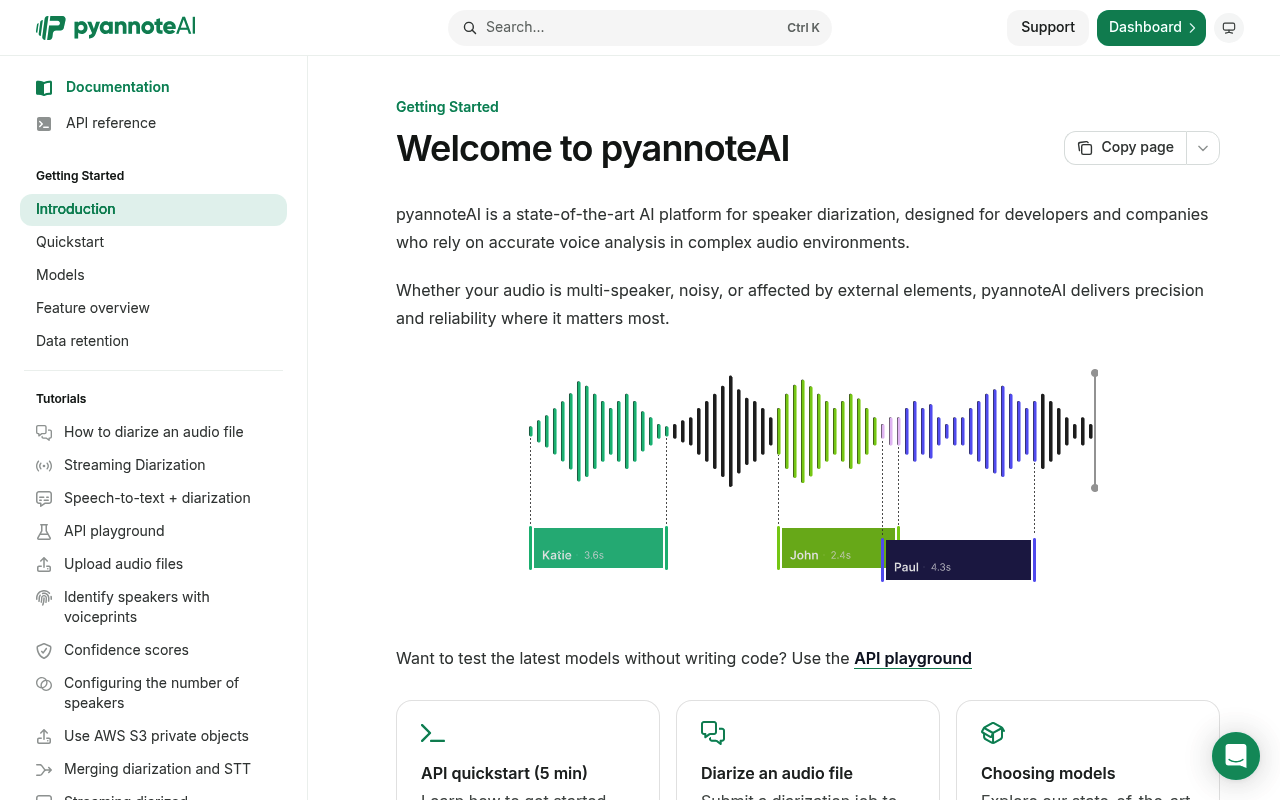
pyannoteAI builds speaker intelligence infrastructure for voice AI: a hosted REST and WebSocket API that answers "who spoke when" (speaker diarization) and "who is speaking" (speaker identification via voiceprints) for both batch audio files and live streams. The company commercializes the widely adopted open-source pyannote.audio library, offering batch diarization, real-time streaming diarization over a WebSocket gateway, voiceprint enrollment and matching, and speech-to-text orchestration that returns speaker-attributed transcripts in a single call. Developers authenticate with a bearer API key, submit asynchronous jobs, and receive results by polling or signed webhooks.
Solid contracts, transparent operations, and an easy start — typically complete on four or five facets with one clear soft spot.

API Evangelist profiles PyannoteAI the way a machine reads it — 20 machine-readable artifacts across 1 API, pulled from the provider's own public surface and indexed so a developer, an analyst, or an AI agent can evaluate it against every other provider on the network.
Every provider in the network is reduced to the same set of machine-readable artifacts — OpenAPI contracts, event specifications, GraphQL schemas, runnable collections, pricing and rate-limit signals, security posture, OAuth scopes, and the agent surfaces (MCP servers and skills) that let software drive the API on its own. We profile them because the interface is the part of a company you can actually inspect: it is a truer signal of what a provider does than any marketing page. From those artifacts we compute the Kin Score — PyannoteAI scores 65.7/100 (strong), with a separate agent-readiness read of 37/100 (agent ready). The full breakdown is below, followed by every artifact we hold — each card links through to its machine-readable definition on apis.io.
Kin Score
This is the API Evangelist rating — a single, repeatable read computed from the artifacts on this page. Green fill is points earned; the red track is points possible, so every bar shows earned-versus-possible at a glance. Every facet and dimension name is a link: it opens that measurement's page on APIs.io, where the rating runs across the whole catalog — the exact checks that feed it, how every profiled provider distributes on it, and who is at the top of it.
Kin Score
How this is scored →scored 2026-11-06 · rubric v0.27.0

Put this on your own site. The badge is drawn live from PyannoteAI's current Kin Score — paste it once and it updates itself every time the score is recomputed. It follows your visitor's light or dark setting, and it links back here so anyone who sees it can read the full breakdown.
<!-- Kin Score · API Evangelist -->
<a href="https://providers.apievangelist.com/providers/pyannoteai/"
   title="PyannoteAI on API Evangelist — API profile and Kin Score">
  <img src="https://apis.io/badge/pyannoteai.svg"
       alt="PyannoteAI Kin Score — API readiness rating by API Evangelist" width="150" height="150" loading="lazy">
</a>[](https://providers.apievangelist.com/providers/pyannoteai/)<!-- Kin Score · API Evangelist -->
<a href="https://providers.apievangelist.com/providers/pyannoteai/"
title="PyannoteAI on API Evangelist — API profile and Kin Score">
<img src="https://apis.io/badge/pyannoteai/card.svg"
alt="PyannoteAI Kin Score — API readiness rating by API Evangelist" width="340" height="120" loading="lazy">
</a>More shapes, themes and sizes → · Score as JSON · How badges work
How we profile PyannoteAI
Each block below is one kind of artifact we hold for PyannoteAI. For each we say what it is and why it earns a place in the profile, then list every one we've indexed — capped at two rows, scroll within the panel for the rest.
APIs 5
Each API is captured as its own OpenAPI definition — every operation, parameter, and response. This is the single most useful machine-readable description of what an API does, and it's what lets us score, lint, mock, and generate against it without asking the provider for anything.
Individual APIs this provider publishes, each with its own machine-readable definition.
PyannoteAI Media API
The Media API from PyannoteAI — 2 operation(s) for media.
PyannoteAI Streaming API
The Streaming API from PyannoteAI — 2 operation(s) for streaming.
PyannoteAI Jobs API
The Jobs API from PyannoteAI — 2 operation(s) for jobs.
PyannoteAI Operations API
The Operations API from PyannoteAI — 3 operation(s) for operations.
PyannoteAI Test API
The Test API from PyannoteAI — 1 operation(s) for test.
MCP Servers 1
Model Context Protocol servers expose these APIs directly to AI agents. We profile them because agent-native access is the fastest-growing way this provider's capabilities actually get used.
Model Context Protocol servers that expose these APIs to AI agents.
Agent Skills 4
An agent skill packages the how-to for driving these APIs from an assistant — the prompts, the sequence, the guardrails — so the knowledge to use the API travels with it.
Packaged agent skills for driving this provider's APIs from an AI assistant.
pyannoteai-diarize-audio
AGENT SKILLpyannoteai-identify-speakers
AGENT SKILLPyannote
AGENT SKILLpyannoteai-stream-live-diarization
AGENT SKILLPricing Plans 2
Pricing is part of the interface. Machine-readable plans tell you what a tier costs and includes before you commit — one of the things the Kin Score reads for access clarity — renamed from commercial clarity in rubric 0.12, because a free statutory interface has access terms and no commercial ones.
Published pricing tiers and plan structures.
Rate Limits 1
Rate limits are the difference between a demo that works and a production integration that doesn't fall over. Publishing them is an operational-transparency signal — and a hard requirement for any agent that plans its own throughput.
Documented rate limits and quota policies.
Pyannoteai Rate Limits
RATE LIMITSFinOps 1
Cost, billing, and metering signals let a buyer model the financial operations of an API before it's live. We profile them for the same reason we profile pricing: the money is part of the contract.
Cost, billing, and metering signals for API financial operations.
Pyannoteai Finops
FINOPSEvent Specifications 2
Not every API is request/response. AsyncAPI describes the event-driven and streaming side — the webhooks and channels — so the asynchronous half of the interface is documented the same way the synchronous half is.
AsyncAPI definitions for this provider's event-driven and streaming APIs.
pyannoteAI WebSocket Gateway API
Streaming WebSocket gateway for real-time speaker diarization.
ASYNCAPIPyannoteai Webhooks
ASYNCAPISpectral Rules 1
Governance rulesets we run against this provider's specs — the automated checks behind parts of the score. Profiling them makes the quality bar explicit and re-runnable, not a matter of opinion.
PyannoteAI API Rules
SPECTRALSecurity Posture 3
Authentication, domain security, vulnerability disclosure, and trust-center signals — the evidence that a provider takes security seriously enough to document it. We profile it because you can't govern what you can't see.
Authentication, domain security, vulnerability disclosure, and trust-center signals.
Resources
Every other property we hold for PyannoteAI — documentation, portals, status pages, policies, and corporate surface — grouped by the job it does, following the integrator's arc from getting started to running in production.
Get Started 4
Portal, sign-up, and the first successful call
Documentation 2
Reference material describing how the API behaves
Agent Surfaces 4
MCP servers, agent skills, and machine-readable catalogs
Design & Contract 6
Pagination, idempotency, versioning, errors, and events
Build 3
SDKs, sample code, and the tooling you integrate with
Access & Security 5
Authentication, authorization, and security posture
Operate 4
Status, limits, changes, and where to get help
Commercial 4
Pricing, plans, and the legal terms of use
Company 2
The organization behind the API
Other 2
Properties that don't map to a standard resource type
← All providers · Data indexed from github.com/api-evangelist/pyannoteai · machine-readable index on apis.io
This is an independent, third-party profile of PyannoteAI, published by API Evangelist. We do not operate, host, resell, or support these APIs, and we are not affiliated with or endorsed by the company unless stated above. Everything here is built from publicly available information — the company's own site, developer portal, documentation, public repositories, and the specifications it publishes for public use. Nothing is obtained by breaching a system, defeating an access control, or using credentials.
The Kin Score and Agent Readiness rating are independently calculated assessments of a company's public API artifacts, scored against a published rubric. They are not certifications, endorsements, security assessments, or audits.
Corrections, re-scores, and removal are free — no partnership or purchase required, and you do not need to justify the request. A removed company is recorded as unrated, never scored zero for having asked. Acknowledgement within one business day; removal within two.
info@apievangelist.com
·
Read the full data-sourcing policy →
On a security or compliance team? Put security in the subject line and
you will get a person, not a form — we will tell you exactly which public URLs this profile was built from.