
Stark Bank
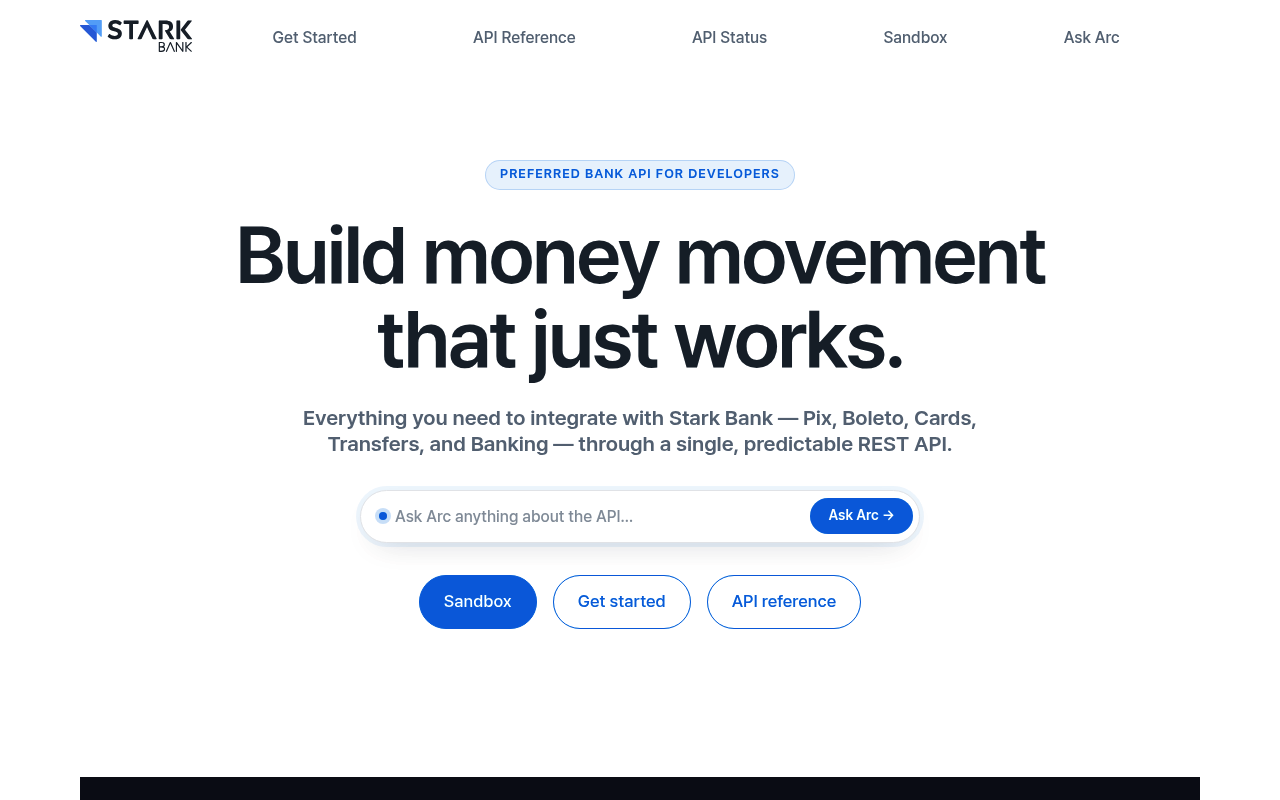
Stark Bank is a regulated Brazilian financial institution (authorized by the Banco Central do Brasil, not a payment service provider) that exposes end-to-end money movement through a single RESTful JSON API. Businesses collect money with Pix Invoices, Pix QR codes, Pix subscriptions, Boletos, card payments and marketplace split receivables, and pay out with Pix/TED Transfers, Boleto, BR Code, utility, tax and DARF payments plus approval-gated Payment Requests. Received funds land directly in the account balance with no wallet or payout step. The v2 OpenAPI 3.1 API (143 operations) authenticates with ECDSA request signing rather than API keys or OAuth, offers a production-identical sandbox, cursor pagination, externalId idempotency and signed webhook events, and ships nine official SDKs (Python, Node, Go, Java, Ruby, PHP, .NET, Elixir, Clojure).
Real signal across most facets with visible, nameable gaps — the contract exists but is thin, or the portal is good while governance and commercial terms are absent.

API Evangelist profiles Stark Bank the way a machine reads it — 68 machine-readable artifacts across 1 API, pulled from the provider's own public surface and indexed so a developer, an analyst, or an AI agent can evaluate it against every other provider on the network.
Every provider in the network is reduced to the same set of machine-readable artifacts — OpenAPI contracts, event specifications, GraphQL schemas, runnable collections, pricing and rate-limit signals, security posture, OAuth scopes, and the agent surfaces (MCP servers and skills) that let software drive the API on its own. We profile them because the interface is the part of a company you can actually inspect: it is a truer signal of what a provider does than any marketing page. From those artifacts we compute the Kin Score — Stark Bank scores 52.5/100 (developing), with a separate agent-readiness read of 34/100 (agent ready). The full breakdown is below, followed by every artifact we hold — each card links through to its machine-readable definition on apis.io.
Kin Score
This is the API Evangelist rating — a single, repeatable read computed from the artifacts on this page. Green fill is points earned; the red track is points possible, so every bar shows earned-versus-possible at a glance. Every facet and dimension name is a link: it opens that measurement's page on APIs.io, where the rating runs across the whole catalog — the exact checks that feed it, how every profiled provider distributes on it, and who is at the top of it.
Kin Score
How this is scored →scored 2026-10-17 · rubric v0.24.0

Put this on your own site. The badge is drawn live from Stark Bank's current Kin Score — paste it once and it updates itself every time the score is recomputed. It follows your visitor's light or dark setting, and it links back here so anyone who sees it can read the full breakdown.
<!-- Kin Score · API Evangelist -->
<a href="https://providers.apievangelist.com/providers/stark-bank/"
   title="Stark Bank on API Evangelist — API profile and Kin Score">
  <img src="https://apis.io/badge/stark-bank.svg"
       alt="Stark Bank Kin Score — API readiness rating by API Evangelist" width="150" height="150" loading="lazy">
</a>[](https://providers.apievangelist.com/providers/stark-bank/)<!-- Kin Score · API Evangelist -->
<a href="https://providers.apievangelist.com/providers/stark-bank/"
title="Stark Bank on API Evangelist — API profile and Kin Score">
<img src="https://apis.io/badge/stark-bank/card.svg"
alt="Stark Bank Kin Score — API readiness rating by API Evangelist" width="340" height="120" loading="lazy">
</a>More shapes, themes and sizes → · Score as JSON · How badges work
How we profile Stark Bank
Each block below is one kind of artifact we hold for Stark Bank. For each we say what it is and why it earns a place in the profile, then list every one we've indexed — capped at two rows, scroll within the panel for the rest.
APIs 31
Each API is captured as its own OpenAPI definition — every operation, parameter, and response. This is the single most useful machine-readable description of what an API does, and it's what lets us score, lint, mock, and generate against it without asking the provider for anything.
Individual APIs this provider publishes, each with its own machine-readable definition.
Stark Bank Balance API
The balance entity holds the total funds available in your workspace and can be calculated as the sum of its transactions (cash-in + cash-out). Therefore, you can also interpret...
Stark Bank Boleto API
A boleto is a method you can use to charge your customers or load your Stark Bank account. Here we will teach you how to create and manage boletos. You can also split a Boleto b...
Stark Bank Boleto Holmes API
Honoring the famous Sherlock Holmes, this feature allows your application to investigate updated boleto status according to CIP in less than an hour. Here we will teach you how ...
Stark Bank Boleto Payment API
Here we will teach you how to create and manage boleto payments.
Stark Bank Brcode Payment API
Here we will teach you how to create and manage brcode payments.
Stark Bank Darf Payment API
Here we will explain how to manually pay DARFs without bar codes.
Stark Bank Deposit API
Deposits represent passive cash-ins received by your account from external transfers or payments. In this section, we will teach you how to manage your Deposits.
Stark Bank Dynamic Brcode API
Note:This is a basic Pix QR Code solution for one time payment. For a complete Pix QR Code receivable, check the Invoice resource. When a Dynamic Brcode is paid, a Deposit is cr...
Stark Bank Event API
Every time a log is created, a corresponding event will be generated and sent to you by webhook, if the appropriate subscription was set. Therefore, the event represents an occu...
Stark Bank Event Attempt API
When an Event delivery fails, an event attempt will be registered. It carries information meant to help you debug event reception issues.
Stark Bank Institutions API
An Institution is used to query institutions registered by the Brazilian Central Bank for Pix and Ted transactions.
Stark Bank Invoice API
The Invoice resource is used to request payments from customers. Your customer can pay it by scanning the Pix QR Code or making a deposit to the indicated account number. You ca...
Stark Bank Invoice Pull Request API
An Invoice Pull Request is a command sent to the payer's bank to trigger the automatic debit of a previously issued invoice linked to an active Invoice Pull Subscription. It con...
Stark Bank Invoice Pull Subscription API
An Invoice Pull Subscription is a recurring payment agreement between a payer and a receiver, authorized through the Pix Automatic infrastructure. Once active, it allows the rec...
Stark Bank Merchant Card API
The Merchant Card resource stores information about cards used in approved purchases. These cards can be used in new purchases without the need to create a new session.
Stark Bank Merchant Installment API
Merchant Installments are created for every installment in a purchase. These resources will track its own due payment date and settlement lifecycle.
Stark Bank Merchant Purchase API
The Merchant Purchase resource can be used to charge customers with credit or debit cards. If a card hasn't been used before, a Merchant Session Purchase must be created and app...
Stark Bank Merchant Session API
The Merchant Session resource can be created by a merchant and used by the card holder in order to collect their card data without having to handle it on the merchant's side. Th...
Stark Bank Payment Preview API
A Payment Preview is used to get information from multiple types of payment to confirm any information before actually paying. If the 'scheduled' parameter is not informed, toda...
Stark Bank Payment Request API
Here we will teach you how to create and manage your payment requests. The payment request is the main element of our approval flow, which can be checked out by logging into our...
Stark Bank Pix Key API
The Pix keys are saved in the DICT (Diretório de Identificadores de Contas Transacionais), the centralized Pix service managed by Bacen (Brazilian Central Bank) that allows you ...
Stark Bank Public Key API
Some of our responses will be signed using our own private key, such as the messages we send by webhook. In order to verify that it was really us that generated the message, you...
Stark Bank Split API
The Split resource is used to split an Invoice or Boleto between different receivers.
Stark Bank Split Profile API
The Split Profile resource is used to configure the behavior of split operations.
Stark Bank Split Receiver API
You can create a Receiver to an Invoice or Boleto split by using the Split Receiver resource.
Stark Bank Tax Payment API
Here we will explain how to create and manage tax payments, such as ISS and DAS.
Stark Bank Transaction API
Since Stark Bank is centralized, we have a private ledger to keep track of all transactions. It's important to understand that every financial operation in Stark Bank generates ...
Stark Bank Transfer API
Transfers are used to send money to any bank account in Brazil using the Ted or Pix systems. Here we will show you how to create and manage them.
Stark Bank Utility Payment API
Here we will teach you how to create and manage utility payments, such as electricity and water bills.
Stark Bank Webhook API
You can create webhook subscriptions to receive events whenever a new log is created. We send the event by making a POST request to your endpoint URL. The event will be delivere...
Stark Bank Workspace API
Workspaces are bank accounts. They have independent balances, statements, operations and permissions. The only property that is shared between your workspaces is the link they h...
Scroll within the panel for all 31 ·
Open Collections 31
Open, tool-agnostic collections carry the same runnable value as Postman without locking you to one client — the portable, forkable form of the same exercise.
Open, tool-agnostic API collections (OpenAPI-derived and Bruno).
API Collection
OPEN COLLECTIONStark Bank Balance API
OPEN COLLECTIONStark Bank Balance Boleto API
OPEN COLLECTIONStark Bank Balance Boleto Holmes API
OPEN COLLECTIONStark Bank Balance Boleto Payment API
OPEN COLLECTIONStark Bank Balance Brcode Payment API
OPEN COLLECTIONStark Bank Balance Darf Payment API
OPEN COLLECTIONStark Bank Balance Deposit API
OPEN COLLECTIONStark Bank Balance Dynamic Brcode API
OPEN COLLECTIONStark Bank Balance Event API
OPEN COLLECTIONStark Bank Balance Event Attempt API
OPEN COLLECTIONStark Bank Balance Institutions API
OPEN COLLECTIONStark Bank Balance Invoice API
OPEN COLLECTIONStark Bank Balance Invoice Pull Request API
OPEN COLLECTIONStark Bank Balance Invoice Pull Subscription API
OPEN COLLECTIONStark Bank Balance Merchant Card API
OPEN COLLECTIONStark Bank Balance Merchant Installment API
OPEN COLLECTIONStark Bank Balance Merchant Purchase API
OPEN COLLECTIONStark Bank Balance Merchant Session API
OPEN COLLECTIONStark Bank Balance Payment Request API
OPEN COLLECTIONStark Bank Balance Pix Key API
OPEN COLLECTIONStark Bank Balance Public Key API
OPEN COLLECTIONStark Bank Balance Split API
OPEN COLLECTIONStark Bank Balance Split Profile API
OPEN COLLECTIONStark Bank Balance Split Receiver API
OPEN COLLECTIONStark Bank Balance Tax Payment API
OPEN COLLECTIONStark Bank Balance Transaction API
OPEN COLLECTIONStark Bank Balance Transfer API
OPEN COLLECTIONStark Bank Balance Utility Payment API
OPEN COLLECTIONStark Bank Balance Webhook API
OPEN COLLECTIONStark Bank Balance Workspace API
OPEN COLLECTIONScroll within the panel for all 31 ·
Pricing Plans 2
Pricing is part of the interface. Machine-readable plans tell you what a tier costs and includes before you commit — one of the things the Kin Score reads for access clarity — renamed from commercial clarity in rubric 0.12, because a free statutory interface has access terms and no commercial ones.
Published pricing tiers and plan structures.
Event Specifications 1
Not every API is request/response. AsyncAPI describes the event-driven and streaming side — the webhooks and channels — so the asynchronous half of the interface is documented the same way the synchronous half is.
AsyncAPI definitions for this provider's event-driven and streaming APIs.
Stark Bank Events Webhooks
ASYNCAPISecurity Posture 3
Authentication, domain security, vulnerability disclosure, and trust-center signals — the evidence that a provider takes security seriously enough to document it. We profile it because you can't govern what you can't see.
Authentication, domain security, vulnerability disclosure, and trust-center signals.
Resources
Every other property we hold for Stark Bank — documentation, portals, status pages, policies, and corporate surface — grouped by the job it does, following the integrator's arc from getting started to running in production.
Get Started 4
Portal, sign-up, and the first successful call
Documentation 2
Reference material describing how the API behaves
Agent Surfaces 3
MCP servers, agent skills, and machine-readable catalogs
Design & Contract 7
Pagination, idempotency, versioning, errors, and events
Scroll within the panel for all 7 ·
Build 4
SDKs, sample code, and the tooling you integrate with
Access & Security 4
Authentication, authorization, and security posture
Operate 2
Status, limits, changes, and where to get help
Commercial 2
Pricing, plans, and the legal terms of use
Company 3
The organization behind the API
Other 2
Properties that don't map to a standard resource type
← All providers · Data indexed from github.com/api-evangelist/stark-bank · machine-readable index on apis.io
This is an independent, third-party profile of Stark Bank, published by API Evangelist. We do not operate, host, resell, or support these APIs, and we are not affiliated with or endorsed by the company unless stated above. Everything here is built from publicly available information — the company's own site, developer portal, documentation, public repositories, and the specifications it publishes for public use. Nothing is obtained by breaching a system, defeating an access control, or using credentials.
The Kin Score and Agent Readiness rating are independently calculated assessments of a company's public API artifacts, scored against a published rubric. They are not certifications, endorsements, security assessments, or audits.
Corrections, re-scores, and removal are free — no partnership or purchase required, and you do not need to justify the request. A removed company is recorded as unrated, never scored zero for having asked. Acknowledgement within one business day; removal within two.
info@apievangelist.com
·
Read the full data-sourcing policy →
On a security or compliance team? Put security in the subject line and
you will get a person, not a form — we will tell you exactly which public URLs this profile was built from.