
Stori
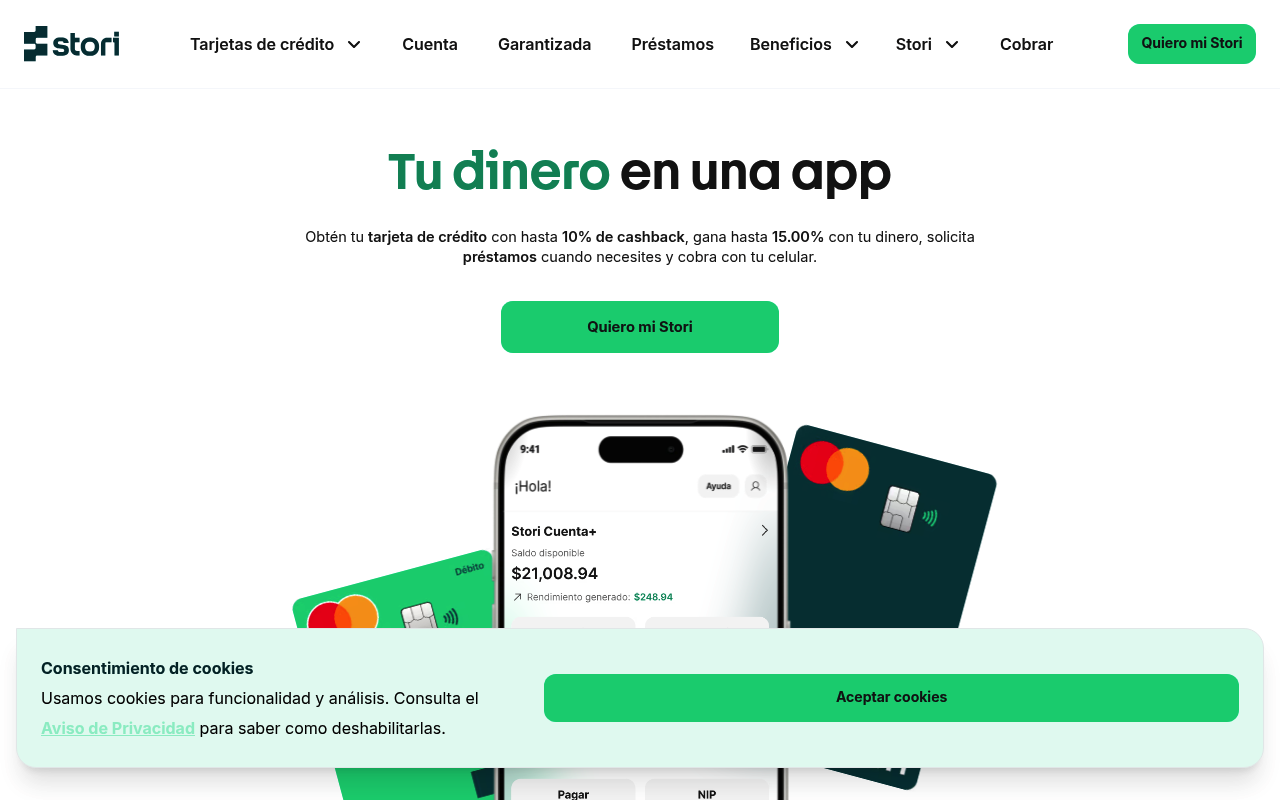
Stori is a Mexico City–headquartered fintech (operating as a regulated Sociedad Financiera Popular under CNBV and CONDUSEF oversight) on a mission to democratize credit access for the roughly 400 million underbanked consumers in Latin America. Founded in 2019, the company achieved unicorn status in 2022 and has raised over $400M from investors including GGV Capital, General Catalyst, Lightspeed Venture Partners, Goodwater Capital, Source Code Capital, Vision Plus Capital, BAI Capital, Tresalia, and GIC. Stori's flagship product is the Stori Card, an inclusive Visa credit card marketed to first-time borrowers with little or no formal credit history, alongside Stori Black (premium tier), co-branded cards (SHEIN, Farmacias Similares, sports teams), Cuenta+ (a commission-free deposit account advertising up to 15% annual returns), personal loans up to roughly $3,000 MXN-equivalent, and payment services covering bill pay, mobile recharges, and phone-based merchant collection. The platform is delivered exclusively through its iOS and Android mobile apps and serves more than five million Mexican users. Stori has no public developer API, SDK, CLI, webhook surface, or open-source release; its revenue model is interest, interchange, and fee income from consumer credit and deposit products, with operations in Mexico, Colombia, and a U.S. corporate presence in Arlington, Virginia.
Index entry only — little beyond a description and a link, and nothing machine-readable enough for an agent to act on without a human reading the site first.

API Evangelist profiles Stori the way a machine reads it — 1 machine-readable artifact, pulled from the provider's own public surface and indexed so a developer, an analyst, or an AI agent can evaluate it against every other provider on the network.
Every provider in the network is reduced to the same set of machine-readable artifacts — OpenAPI contracts, event specifications, GraphQL schemas, runnable collections, pricing and rate-limit signals, security posture, OAuth scopes, and the agent surfaces (MCP servers and skills) that let software drive the API on its own. We profile them because the interface is the part of a company you can actually inspect: it is a truer signal of what a provider does than any marketing page. From those artifacts we compute the Kin Score — Stori scores 2.9/100 (minimal), with a separate agent-readiness read of 0/100 (human only). The full breakdown is below, followed by every artifact we hold — each card links through to its machine-readable definition on apis.io.
Kin Score
This is the API Evangelist rating — a single, repeatable read computed from the artifacts on this page. Green fill is points earned; the red track is points possible, so every bar shows earned-versus-possible at a glance. Every facet and dimension name is a link: it opens that measurement's page on APIs.io, where the rating runs across the whole catalog — the exact checks that feed it, how every profiled provider distributes on it, and who is at the top of it.
Kin Score
How this is scored →scored 2026-10-17 · rubric v0.24.0

Put this on your own site. The badge is drawn live from Stori's current Kin Score — paste it once and it updates itself every time the score is recomputed. It follows your visitor's light or dark setting, and it links back here so anyone who sees it can read the full breakdown.
<!-- Kin Score · API Evangelist -->
<a href="https://providers.apievangelist.com/providers/stori/"
   title="Stori on API Evangelist — API profile and Kin Score">
  <img src="https://apis.io/badge/stori.svg"
       alt="Stori Kin Score — API readiness rating by API Evangelist" width="150" height="150" loading="lazy">
</a>[](https://providers.apievangelist.com/providers/stori/)<!-- Kin Score · API Evangelist -->
<a href="https://providers.apievangelist.com/providers/stori/"
title="Stori on API Evangelist — API profile and Kin Score">
<img src="https://apis.io/badge/stori/card.svg"
alt="Stori Kin Score — API readiness rating by API Evangelist" width="340" height="120" loading="lazy">
</a>More shapes, themes and sizes → · Score as JSON · How badges work
How we profile Stori
Each block below is one kind of artifact we hold for Stori. For each we say what it is and why it earns a place in the profile, then list every one we've indexed — capped at two rows, scroll within the panel for the rest.
Security Posture 1
Authentication, domain security, vulnerability disclosure, and trust-center signals — the evidence that a provider takes security seriously enough to document it. We profile it because you can't govern what you can't see.
Authentication, domain security, vulnerability disclosure, and trust-center signals.
Resources
Every other property we hold for Stori — documentation, portals, status pages, policies, and corporate surface — grouped by the job it does, following the integrator's arc from getting started to running in production.
Access & Security 1
Authentication, authorization, and security posture
Company 7
The organization behind the API
Scroll within the panel for all 7 ·
Other 6
Properties that don't map to a standard resource type
← All providers · Data indexed from github.com/api-evangelist/stori · machine-readable index on apis.io
This is an independent, third-party profile of Stori, published by API Evangelist. We do not operate, host, resell, or support these APIs, and we are not affiliated with or endorsed by the company unless stated above. Everything here is built from publicly available information — the company's own site, developer portal, documentation, public repositories, and the specifications it publishes for public use. Nothing is obtained by breaching a system, defeating an access control, or using credentials.
The Kin Score and Agent Readiness rating are independently calculated assessments of a company's public API artifacts, scored against a published rubric. They are not certifications, endorsements, security assessments, or audits.
Corrections, re-scores, and removal are free — no partnership or purchase required, and you do not need to justify the request. A removed company is recorded as unrated, never scored zero for having asked. Acknowledgement within one business day; removal within two.
info@apievangelist.com
·
Read the full data-sourcing policy →
On a security or compliance team? Put security in the subject line and
you will get a person, not a form — we will tell you exactly which public URLs this profile was built from.